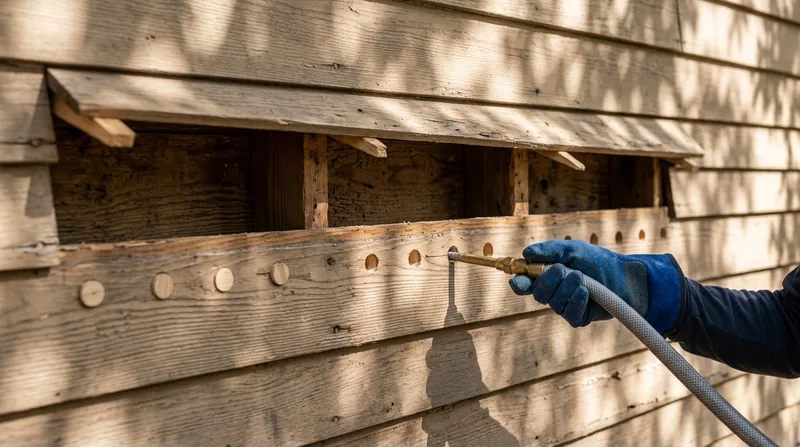




Wall & Injection Foam Insulation in College Station addresses one of the oldest and most common insulation gaps in the Brazos Valley: the uninsulated exterior walls of pre-1980 homes and the rim joists that sit above concrete slabs or pier-and-beam foundations. College Station and Bryan hold thousands of 1940s through 1970s cottages, brick ranches, and Victorians in the historic districts of Navasota and Brenham with hollow wall cavities that were never filled, or filled with fiberglass that has settled, compacted, or never performed in the first place. Modern two-story brick homes around College Hills and near campus often have rim joists and band joists left open or poorly insulated, allowing warm attic air and cold winter drafts to leak directly into living spaces. Injection foam and wall cavity foam seal these gaps without demolition, restore thermal resistance, and stop air leakage that fiberglass alone cannot address. We have been serving College Station and the surrounding Brazos Valley since 2012, and we work year-round to help homeowners and builders close these thermal boundaries correctly.
Why Wall & Injection Foam Insulation Matters in College Station's Older Housing Stock
The majority of College Station's residential neighborhoods were built before energy codes required proper wall insulation or air sealing. Homes in Bryan's Eastside historic district, downtown Navasota, and Brenham's Victorian corridors often have hollow walls with no insulation at all, or with degraded fiberglass that no longer fills the cavity. In the post-oak and live-oak shade of these older streets, summer heat gain through uninsulated walls and rim joists forces air conditioning systems to work harder, and winter cold seeps in around band joists and through open cavities where water lines and electrical chases run. Injection foam and closed-cell wall foam fill these voids completely, eliminate air leakage, and restore the thermal envelope without tearing out walls or disturbing plaster, siding, or historic finishes.
- Injection foam fills settled or missing fiberglass in existing wall cavities without demolition or interior disruption.
- Closed-cell foam in rim joists and band joists stops air leakage and provides R-value per inch that fiberglass cannot match.
- Wall cavity foam works on pre-1980 frame homes, brick veneer over wood, and modern two-stories with uninsulated exterior walls or bonus room additions.
- We drill small ports into exterior walls or rim joist skirting, inject foam to full density, and patch the holes to match the existing finish.
This method preserves the integrity of older homes while closing the air leaks that dominate energy loss in the Brazos Valley's hot, humid summers and occasional hard freezes.
Key info: Winter Storm Uri in 2021 exposed the vulnerability of uninsulated rim joists across Greater College Station when attic water lines froze and burst. Homes with properly insulated and air-sealed rim joists and band joists experienced far fewer ruptures. Injection foam closes these thermal weak points year-round.
How We Install Wall & Injection Foam Insulation in College Station Homes
Our process begins with an on-site assessment to locate wall cavities, identify rim joists and band joists that need sealing, and determine whether the existing insulation is settled, missing, or contaminated. We map out the wall sections, measure cavity depth and width, and verify that the substrate is dry before we proceed. Once we confirm the conditions are right, we drill small access ports (typically 1.5 to 2 inches), inject closed-cell or open-cell foam to full density at the correct ratio and temperature, allow the foam to cure, and patch the holes to blend with the existing exterior or interior finish. For rim joist and band joist sealing, we often work from the crawl space or basement side, injecting foam into the band joist cavity to stop air leakage into the rim space and living areas above.
- We inspect the wall cavity and rim joist for moisture, settling, and existing insulation condition before any foam is applied.
- We drill access ports at measured intervals, typically 16 to 24 inches apart, to ensure complete fill without voids or cold spots.
- We inject foam at the correct manufacturer ratio, drum temperature, and nozzle pressure to achieve full density and R-value per pass.
- We monitor cure time and ventilation during application, maintaining mechanical airflow to manage off-gassing and vapor release.
- We patch all ports with foam-compatible sealant or caulk and sand or paint to match the existing finish.
The entire process is non-invasive and preserves the structure, finishes, and character of older homes while closing the thermal leaks that fiberglass alone cannot address.
Example: A 1960s brick ranch in College Hills with hollow brick veneer walls and an open rim joist over a concrete slab had no wall insulation and significant air leakage around the perimeter. We injected closed-cell foam into the brick cavity and rim joist space, sealed the band joist, and eliminated the cold draft that had been pulling air from the crawl space into the living room. The homeowner reported noticeably warmer floors and more even temperatures within the first week of cure.
Wall & Injection Foam Insulation Methods for College Station Applications
| Approach | Description | Best for |
|---|---|---|
| Closed-Cell Wall Injection | High-density foam (3.5 to 3.8 lb/cu ft) injected into wall cavities and rim joists; full R-value per inch with air-sealing properties and moisture resistance. | Rim joists, band joists, exterior walls with moisture exposure, and homes in humid climates where vapor control matters. |
| Open-Cell Wall Injection | Lower-density foam (0.5 to 0.6 lb/cu ft) injected into interior wall cavities; breathable, sound-dampening, and cost-effective for non-moisture-critical applications. | Interior walls, bonus rooms, and additions where air sealing is the priority and moisture exposure is minimal. |
| Rim Joist Sealing | Closed-cell foam applied to the band joist cavity and the rim space above concrete slabs or pier-and-beam foundations; blocks air leakage and thermal bridging. | All homes in College Station; critical after Winter Storm Uri to prevent burst water lines and thermal loss. |
| Cavity Fill Without Demolition | Injection foam installed into existing wall cavities of 1940s through 1970s homes via small exterior or interior access ports; no wall removal or interior disruption. | Historic homes, brick ranches, cottages, and any structure where preserving the original finish is essential. |
Wall & Injection Foam Insulation Cost in College Station: What to Expect
Wall and injection foam insulation in College Station typically starts at $2.00 to $3.50 per square foot of wall area or rim joist linear footage, depending on cavity depth, wall height, foam density, and ease of access. A typical 1,200-square-foot ranch with hollow exterior walls and uninsulated rim joists might run $3,000 to $5,000 for a complete wall and rim joist treatment; a single-story cottage with smaller wall area might fall in the $1,500 to $2,500 range. Closed-cell foam costs more per board foot than open-cell because it delivers higher R-value per inch and provides moisture resistance, which is essential for rim joists and moisture-exposed cavities in the Brazos Valley's humid climate. Access difficulty, wall configuration, and whether the foam is applied from the exterior (requiring drilling through siding or brick) or interior (requiring interior wall access) all affect the final cost. The best way to understand what your home will cost is to request a free written estimate that specifies R-value, thickness per pass, and board feet of foam required.
We provide written estimates with R-value and thickness specifications so you know exactly what you are paying for and why. Compare estimates from multiple contractors, verify that each one specifies foam density, R-value per inch, and the total board feet to be installed, and ask about the cure time and re-entry window they guarantee. A price far below market or an estimate with no R-value or thickness detail is a warning sign. For detailed pricing on various wall and injection foam configurations, see our full pricing overview.
Wall & Injection Foam Insulation Near Me: What College Station Homeowners Should Know When Hiring a Contractor
Hiring the right spray foam contractor for wall and injection foam work requires the same diligence you would apply to any structural or thermal improvement. Ask any contractor for proof of current insurance, a certificate of coverage, and the ability to verify those details with the carrier. Confirm that the contractor carries general liability and property damage insurance covering foam installation and that the coverage is active before work begins. In Texas, spray foam insulation is not licensed at the state level, but many cities in our service area, including College Station, require contractor registration before any work or permitting can proceed. Ask your contractor for their city registration and confirm it directly with the local building department before you sign an agreement. Get written estimates from at least two contractors, and require that each one specify R-value per inch, foam thickness per pass, total board feet, and the cure time and re-entry window they guarantee. Avoid estimates with no technical detail, prices far below market, or promises of immediate re-entry; these are markers of rushed, incomplete, or substandard work. Contact us for a free estimate with full specifications and a timeline you can rely on.
- Verify the contractor's current insurance and confirm coverage with the insurance company before work starts.
- Ask for and confirm any contractor registration required by the City of College Station or your local jurisdiction.
- Request written estimates that specify R-value, thickness per pass, total board feet, and cure time guarantees.
- Check references from recent wall and rim joist foam jobs in College Station or nearby areas.
- Confirm that the contractor will not spray over wet, contaminated, or leaking substrates and will walk away if conditions are not right.
- Understand that permitting and regulations vary by city, and ask your contractor to help you navigate what applies at your address.
A local contractor with a local address, local plates, and a track record in the Brazos Valley is your best protection against out-of-state rig-and-run crews or national franchises that cannot be reached when questions arise after the work is done.
Wall & Injection Foam Insulation in College Station: Pricing Guide
| Service | Price | Details |
|---|---|---|
| Wall Cavity Injection (Open-Cell) | Starting at $2.00/sq ft | Interior wall cavities, sound dampening, lower cost option for non-moisture-critical walls in modern homes |
| Wall Cavity Injection (Closed-Cell) | Starting at $2.75/sq ft | Exterior walls, rim joists, band joists, moisture-exposed cavities; higher R-value and vapor control for humid Brazos Valley climate |
| Rim Joist & Band Joist Sealing | Starting at $3.50/linear ft | Closed-cell foam around perimeter; critical thermal and air-sealing work; cost varies by joist depth and access difficulty |
| Complete Wall & Rim Joist Package | On estimate | Exterior walls plus rim joist sealing for full thermal envelope closure; requires on-site measurement of cavity depth and wall configuration |
| Travel & Estimate | Included | No mileage charge or travel fee in College Station and surrounding service areas; free written estimate within 24 hours |
Indicative pricing, the exact cost depends on square footage, finish, and site access. Free personalized estimate within 24h at (979) 406-5185.


