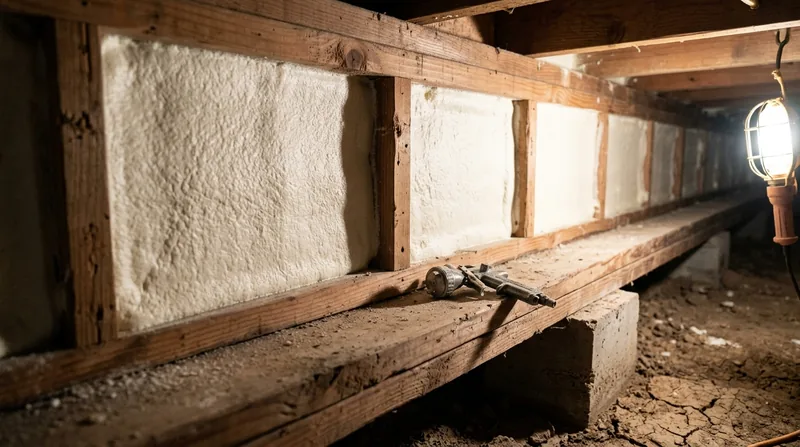




Rim Joist & Band Joist Spray Foam in College Station seals the gap between your foundation and the rim beam where energy leaks, moisture enters, and pests gain access. In the Brazos Valley, where homes sit on concrete slabs or pier-and-beam foundations over open crawl spaces, the rim joist is the forgotten thermal boundary. Summer heat and humidity press into that gap; winter freezes that burst attic lines in 2021 also crack rim joists exposed to the cold. Spray foam closes that leak permanently, stops air infiltration, and protects the band board from moisture and rot. We spray closed-cell or open-cell foam directly onto the rim, seal the rim joist box, and integrate the work with your crawl space or basement insulation strategy. The result is a conditioned rim, lower utility bills, and protection against the freeze-thaw cycles that dominate the College Station winter.
Why Rim Joist Insulation Matters in College Station's Pier-and-Beam Homes
Pier-and-beam construction, common in Bryan, Navasota, and the older neighborhoods of College Station, leaves the rim joist exposed to outdoor air. The rim board sits at the top of the foundation wall, running the perimeter of the house, and it is the first thermal break between the unconditioned crawl space below and the conditioned living space above. Without foam, air flows freely through gaps in the rim, around ductwork, and past electrical penetrations. The band board absorbs moisture from below, and the wood begins to rot. In winter, a hard freeze can split an uninsulated rim joist along the grain. Spray foam stops all three failure modes: it seals the air leak, it blocks moisture from rising into the wood, and it provides a thermal buffer against extreme temperature swings.
- Seal air leaks around the rim joist box where cold drafts and humid air enter the home.
- Protect the band board from moisture wicking up from the crawl space or foundation.
- Reduce heating and cooling load by insulating the thermal boundary between the foundation and the house.
- Create a continuous air barrier when integrated with crawl space insulation or attic spray foam.
- Add structural rigidity to the rim and reduce vibration in pier-and-beam homes.
These five outcomes combine to lower utility costs, extend the life of the rim and band board, and make the home more comfortable year-round.
Key info: Pier-and-beam homes in Bryan's Eastside historic district and Navasota's Victorian neighborhoods are especially vulnerable to rim joist rot because the crawl spaces below are often damp and uninsulated. Spray foam on the rim joist, combined with crawl space insulation, stops moisture at the source and protects the structure.
For more on how spray foam protects the entire foundation zone, see our guide to Crawl Space Spray Foam Insulation.
How We Spray Rim Joist Foam: The Process in College Station Homes
Rim joist spray foam work begins with access. We locate the rim joist from inside the crawl space or basement, or from the exterior if the crawl space is too tight. We inspect the rim board for rot, moisture, and existing insulation. If the rim is wet or heavily contaminated, we do not spray; we walk away and refer you to a moisture or remediation specialist. If the rim is sound, we prepare the surface, set up mechanical ventilation, and spray the foam in controlled passes. Closed-cell foam is the standard for rims because it provides both insulation and a vapor barrier; open-cell foam is used in rare cases where vapor permeability is the goal. Once the foam cures, we trim excess material flush with the rim, and the rim joist box is sealed.
- Inspect the rim joist and band board for rot, moisture, and existing insulation from the crawl space side.
- Prepare the surface by removing loose debris, old insulation, or contamination that would prevent foam adhesion.
- Set up mechanical ventilation to manage off-gassing during the spray and curing phases.
- Spray closed-cell or open-cell foam in multiple thin passes to the specified R-value and thickness.
- Trim excess foam flush with the rim board and inspect the seal for continuity and coverage.
- Verify re-entry conditions (typically 24 to 48 hours) before the homeowner re-occupies the space.
The entire process is coordinated with any crawl space or basement insulation work, so the rim joist foam ties seamlessly into the larger thermal envelope.
Example: A 1950s brick ranch in College Hills with a 1,200-square-foot footprint has a rim joist running 240 linear feet. The rim is 12 inches tall and sits 18 inches above the crawl space floor. We spray 2 inches of closed-cell foam on the rim and band board, achieving R-13 to R-15 thermal resistance. The job takes one day, and the homeowner re-enters after 48 hours. Cost starts at $650 for a small rim joist, but scales with linear footage and access difficulty.
Learn more about how spray foam integrates with your whole-home insulation strategy on our homepage.
Rim Joist Foam Methods: Closed-Cell vs. Open-Cell
| Approach | Description | Best for |
|---|---|---|
| Closed-Cell Spray Foam on Rim Joist | Dense, rigid foam with an R-value of 6 to 7 per inch. Acts as an air barrier and vapor barrier. Provides structural support to the rim board. | Standard choice for rim joists in College Station. Blocks moisture, seals air leaks, and protects the band board in humid crawl spaces. |
| Open-Cell Spray Foam on Rim Joist | Softer, lower-density foam with an R-value of 3.5 to 4 per inch. Vapor-permeable, allowing moisture to pass through. Less expensive than closed-cell. | Rim joists in dry crawl spaces or when vapor permeability is required by code. Rare in the Brazos Valley because humidity is high. |
| Closed-Cell Rim Joist with Crawl Space Integration | Spray foam on the rim joist, walls, and floor of the crawl space as a single sealed system. Encapsulates the entire foundation zone. | Homes where the crawl space is part of the conditioned envelope. Highest performance and moisture control in humid climates. |
| Partial Rim Joist Seal with Existing Insulation | Spray foam applied to gaps, penetrations, and high-leak areas of the rim, leaving existing insulation in place where sound. | Retrofit jobs where the rim has some insulation but air leaks remain. Lower cost than full rim coverage. |
Closed-cell foam dominates rim joist work in the Brazos Valley because the crawl spaces are humid and the risk of moisture damage to the band board is high. Open-cell is used only when a structural engineer or the local building department specifies vapor permeability for a particular foundation condition.
Rim Joist & Band Joist Spray Foam Cost in College Station: What to Expect
Rim joist spray foam pricing depends on the linear footage of rim, the foam type (closed-cell or open-cell), the thickness required by code or design, and access difficulty. A small rim joist on a single-story home with easy crawl space access starts at $650. A larger two-story home with a 300-linear-foot rim, or a job where the crawl space is cramped and requires extra setup time, runs higher. Closed-cell foam costs more per board foot than open-cell, but it is the standard in College Station because of humidity. If the rim board is rotted or wet, we refer you to a moisture specialist first; foam does not go on a compromised substrate.
Factors that move the cost up include:
- Linear footage of rim joist and band board to be insulated.
- Foam type: closed-cell (R-6 to R-7 per inch) or open-cell (R-3.5 to R-4 per inch).
- Thickness required by your local building code or by design (typically 2 to 3 inches on a rim).
- Access difficulty: tight crawl spaces, low headroom, or obstructions add labor time.
- Integration with crawl space or basement insulation work increases the overall project scope.
- Removal of old insulation or contamination before foam is applied.
Every rim joist job includes a free written estimate with R-value and thickness specifications so you know exactly what you are paying for. We respond within 24 hours at (979) 406-5185. For a detailed pricing overview and examples of other insulation work, visit our pricing page.
Real example: A 1,400-square-foot brick ranch in Southside College Station has a 280-linear-foot rim joist, 12 inches tall. The crawl space has some standing water near the foundation but the rim board is dry. We recommend 2.5 inches of closed-cell foam on the rim, tied into crawl space insulation. The rim joist portion of the job runs approximately $950 to $1,200, depending on final access conditions and whether the crawl space work is bundled. A written estimate with R-value and thickness is provided before any work begins.
Rim Joist & Band Joist Spray Foam Near Me: What to Look for When Hiring in College Station
Hiring a spray foam contractor for rim joist work requires the same diligence as any major home improvement. Ask any contractor to explain their estimate in writing, including the R-value and thickness of the foam, the type (closed-cell or open-cell), and the linear footage being covered. Verify that they are fully insured and that their insurance covers spray foam application. Ask for references from recent rim joist or crawl space jobs. Confirm that they understand local building codes: in College Station, attic ventilation and thermal barriers are governed by the energy and building code in force at your address, and the building official is the authority. If your home is in an HOA or a historic district, ask whether exterior work on the foundation will require architectural approval. Check the contractor's experience with crawl space conditions: if your crawl space has moisture, standing water, or mold, the contractor should walk away and refer you to a moisture specialist first, never promise to spray over a wet substrate. Get two or three estimates so you can compare scope, materials, and price.
- Request a written estimate that specifies R-value, thickness, foam type, and linear footage of rim joist to be covered.
- Verify the contractor is fully insured and ask to see a certificate of insurance for spray foam work.
- Ask for references from rim joist or crawl space insulation jobs completed in the last 12 months.
- Confirm the contractor understands College Station building codes and permitting requirements for your address.
- Verify that mechanical ventilation will be used during spray and curing, and ask what the re-entry window is (typically 24 to 48 hours).
- Walk away from any contractor who promises to spray over wet, contaminated, or leaking rim joists, or who offers a price far below market with no inspection.
A reputable local contractor will spend time on site, ask questions about your crawl space and moisture history, provide a detailed written estimate, and explain why certain materials and thicknesses are recommended for your home. For a free estimate and to discuss your rim joist needs, contact us today.
Rim Joist & Band Joist Spray Foam in College Station: Pricing Guide
| Service | Price | Details |
|---|---|---|
| Small rim joist (single-story, easy access) | Starting at $650 | Closed-cell foam on rim joist up to 150 linear feet with straightforward crawl space access and no rot or moisture remediation needed |
| Standard rim joist (two-story or moderate size) | Starting at $1,050 | Closed-cell foam on rim joist 200 to 300 linear feet, includes partial crawl space integration and standard access conditions |
| Large or complex rim joist job | On estimate | Rim joist over 300 linear feet, tight crawl space access, moisture remediation needed, or full crawl space encapsulation planned |
| Open-cell rim joist option | Starting at $550 | Lower cost alternative when vapor permeability is required by code and crawl space humidity is low, rare in College Station market |
| Travel and estimate | Free | No charge for travel within College Station and surrounding service areas, free written estimate with R-value and thickness specs |
Indicative pricing, the exact cost depends on square footage, finish, and site access. Free personalized estimate within 24h at (979) 406-5185.


