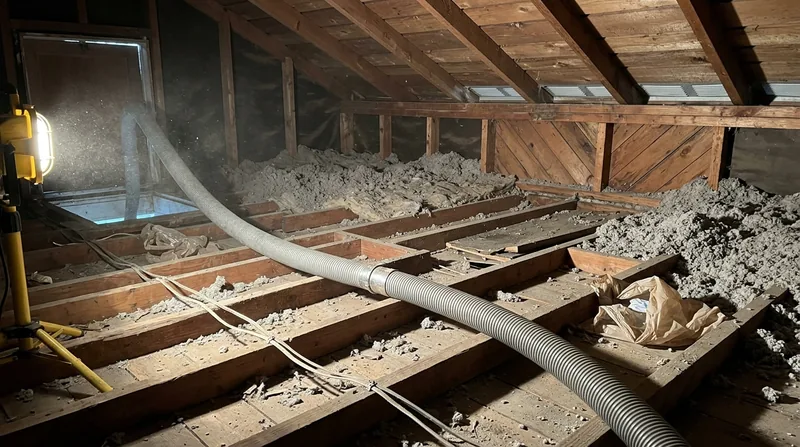




Insulation Removal in College Station is the essential first step before any retrofit or replacement. The Brazos Valley's long, humid summers and hard winter freezes mean that failed insulation, whether settled fiberglass, old cellulose, or foam that has degraded or absorbed moisture, becomes a liability. Attics in College Station hit 140 to 160 degrees Fahrenheit for months at a time, and when the insulation beneath fails, energy bills climb, moisture gets trapped, and the substrate rots. We remove what doesn't work so you can start fresh with the right system. Proper removal is not a shortcut; it is the foundation of any lasting solution, and it is the work we do before we spray.
Why Insulation Removal Matters in College Station and the Brazos Valley
College Station and Bryan sit on rolling post-oak savanna with expansive clay soil, and nearly every house, whether on a concrete slab or on pier-and-beam, runs ductwork and water lines through a vented attic. Older homes in Bryan's Eastside historic district and downtown Navasota and Brenham hold original mineral wool and cellulose that has settled or absorbed decades of humidity. Mid-century cottages and brick ranches on the Southside have compressed fiberglass batts that no longer meet code or perform. Even newer two-stories with vaulted bonus rooms over garages often have foam that was sprayed without proper ventilation, mechanical or otherwise, and has cured with voids, weak adhesion, or trapped moisture. Removing failed insulation is not optional: it is the prerequisite for any retrofit, and it must be done carefully so that the substrate is clean, dry, and ready for the next system.
- We remove settled or compressed fiberglass, mineral wool, and cellulose by hand and with industrial vacuum equipment to capture dust and prevent it from migrating into living spaces.
- We identify and flag moisture damage, mold growth, or structural rot so you know what repair work is needed before we spray new foam.
- We dispose of all removed material in compliance with local waste regulations and in accordance with what the substrate contains.
- We leave the attic, crawl space, or wall cavity clean and ready for closed-cell spray foam, open-cell spray foam, or blown-in replacement insulation.
A clean substrate is the only foundation on which new insulation performs as rated.
Key info: Homes in College Hills and the Edelweiss area often have original attic insulation from the 1960s and 1970s that has settled to half its original thickness. Removal and replacement can restore R-value and stop the energy loss that makes summer cooling bills run high.
How We Remove Insulation: Step-by-Step Process in College Station
Insulation removal is physical work that requires the right equipment, trained crew, and attention to safety and containment. We start with a site assessment to identify what is in the attic or crawl space, whether there is moisture, and what the substrate condition is. We then set up containment and ventilation to prevent dust and debris from entering your home. We remove the insulation systematically, load it into disposal containers, and clean the cavity. The entire process protects your home and your health while preparing the space for what comes next.
- We inspect the attic or crawl space and photograph the existing insulation, moisture condition, and any visible damage to joists, ductwork, or electrical.
- We set up negative air pressure and containment barriers so that dust and old insulation fibers do not escape into your living areas.
- We remove all insulation by hand or with industrial-grade vacuum equipment, depending on the material and access.
- We haul away all debris in our own trucks and dispose of it in accordance with local regulations and the material composition.
- We sweep and vacuum the cavity clean, and we inspect and document the substrate condition so you know what repairs are needed before new insulation is installed.
Once removal is complete and the substrate is dry and clean, we are ready to spray new foam or install replacement insulation.
Example: A 1950s pier-and-beam cottage in downtown Navasota had loose cellulose fill in the attic that had absorbed moisture from humid summers and had settled unevenly. We removed all of it, dried the joists, and then sprayed closed-cell foam to seal and insulate the attic and protect it from future moisture intrusion. The homeowner's cooling bills dropped and the home stayed drier through the next humid season.
Insulation Removal Methods and Materials
| Material or Method | Description | Common in College Station |
|---|---|---|
| Settled Fiberglass Batts | Loose or compressed batts that have lost loft and R-value over decades. Removed by hand or vacuum. | Yes, very common in 1940s-1970s ranch homes and cottages. |
| Cellulose Blown-In | Shredded newspaper or kraft paper insulation that settles and absorbs moisture. Removed with industrial vacuum and bagging. | Yes, often found in older attics and crawl spaces, especially in Bryan and Navasota. |
| Mineral Wool or Rock Wool | Dense, fibrous material that does not settle but can absorb moisture and harbor dust mites. Removed by hand and vacuum. | Yes, found in some 1960s and 1970s homes, especially in historic districts. |
| Degraded or Improperly Applied Foam | Spray foam with voids, poor adhesion, moisture absorption, or off-ratio mixing. Removed mechanically and by hand. | Yes, from prior work by contractors who did not follow proper application or ventilation protocols. |
| Vermiculite or Asbestos-Suspect Material | Lightweight, perlite-like material that may contain asbestos. We do not disturb or remove it; we flag it for testing by a licensed professional. | Possible in homes built before 1980. Left in place and sealed with foam if safe to do so. |
Insulation Removal Cost in College Station: What to Expect
The cost of insulation removal in College Station depends on the size of the space, the type and weight of the material, access, and whether moisture remediation or substrate repair is needed. A straightforward attic removal of settled fiberglass or cellulose in a single-story home typically starts at $950 and can run higher for larger homes, crawl spaces, or material that is wet or contaminated. Removal from a two-story home with a large attic or from a pier-and-beam crawl space will cost more. We provide a free written estimate on site so you know the exact scope and cost before we begin work. For a detailed pricing breakdown and examples of different job types, see our pricing page.
Factors that affect removal cost include the total square footage of the attic or crawl space, the density and weight of the material being removed, whether the material is wet or has absorbed moisture, access and ventilation in the space, and whether structural repair or drying is needed before new insulation is installed. A larger home with a complex attic or a crawl space with standing water or active moisture will cost more than a small, dry attic with loose fiberglass. Getting 2 or 3 estimates from local contractors is always smart, because it helps you understand the scope and see how different crews approach the work.
What to Look for When Hiring an Insulation Removal Contractor Near College Station
Hiring the right contractor for insulation removal is as important as the removal itself. You want a crew that knows how to contain dust, handle old materials safely, dispose of waste properly, and leave your attic or crawl space clean and ready for the next step. Before you hire, ask any contractor for proof of insurance, get a written estimate with a clear scope and price, check references from local homeowners, and verify that they understand any permit or inspection requirements your city has for the work. If your home is in a historic district in Bryan or Navasota, or in an HOA-governed community like Traditions or Southwood Valley, ask whether any architectural approval is needed before removal begins.
- Ask for proof of full insurance coverage and request that the contractor provide a certificate of insurance before work starts.
- Get a written estimate that names the material being removed, the square footage, the disposal method, and the total price with no hidden fees.
- Ask for references from at least two recent jobs in College Station or Bryan, and call them to ask about cleanliness, professionalism, and whether the crew cleaned up afterward.
- Ask whether the contractor has done removal work before new spray foam installation, because the prep work is critical to foam adhesion and performance.
- If your home is in a protected historic district or in an HOA community, confirm that any required approvals are in place before removal begins.
- Verify that the contractor understands local permit and inspection requirements for your specific city and address, and ask the city yourself if you are unsure.
A good contractor will answer your questions directly, provide clear documentation, and be reachable if questions come up during or after the work. Call us at (979) 406-5185 for a free estimate, or visit our contact page to request a site visit.
Insulation Removal in College Station: Pricing Guide
| Service | Price | Details |
|---|---|---|
| Single-story home attic removal | Starting at $950 | Settled fiberglass or cellulose in a dry attic up to 1,500 square feet, hand removal and vacuum, disposal included |
| Two-story home or large attic | Starting at $1,400 | Attic over 1,500 square feet or complex geometry with multiple sections, access challenges, or vented crawl space removal |
| Wet insulation or moisture remediation | Starting at $1,800 | Material that has absorbed water or moisture, requires drying time or substrate repair before new insulation can be applied |
| Crawl space removal with access challenges | On estimate | Pier-and-beam crawl spaces with low headroom, dense material, or contamination require site assessment before pricing |
| Travel and disposal | Included | No mileage fee or travel charge within College Station, Bryan, Navasota, Brenham, and surrounding service areas |
| Free written estimate | No charge | On-site inspection, material identification, square footage measurement, and itemized price quote within 24 hours |
Indicative pricing, the exact cost depends on square footage, finish, and site access. Free personalized estimate within 24h at (979) 406-5185.


