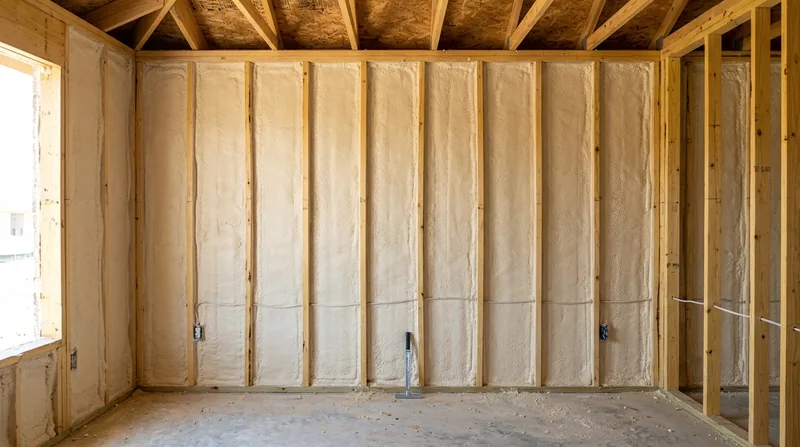




Closed cell spray foam insulation in College Station is the highest-performance choice for attics, crawl spaces, and sealed roof decks in the Brazos Valley, where summer heat climbs to 140-160 degrees and humidity never breaks. College Station homes sit on concrete slabs or pier-and-beam foundations with ductwork and water lines running through vented attics that leak conditioned air and invite moisture into the structure. Closed cell foam solves both problems at once: it seals air leaks, resists moisture, and delivers an R-value of 6.0 to 6.5 per inch, so you stop cooling the attic and start protecting the frame. Whether you own a 1940s brick ranch near downtown, a student rental duplex on Northgate, or a new two-story in Southwood Valley, closed cell foam stops the thermal loss that runs your cooling bill hard from May through September. We have been installing spray foam and air sealing in College Station since 2012, and we know exactly where this product works and where it does not.
Why Closed Cell Spray Foam Matters in College Station's Hot, Humid Climate
The Brazos Valley sits on post-oak savanna and expansive clay with no natural basements, so every home in College Station, Bryan, and the surrounding area vents its attic to the outside. That design works in a dry climate. In East Texas summers, it pulls hot, humid air into the attic and forces your air conditioner to work twice as hard to cool a space that is not even part of your living area. Closed cell foam stops that leak completely and also blocks moisture, which matters because Winter Storm Uri in 2021 burst water lines across the valley and taught every homeowner in this region that a cold snap can turn an attic into a liability. Closed cell foam is denser and more rigid than open cell; it does not sag or compress under the weight of ductwork, and it resists vapor transmission so moisture never gets trapped inside the foam itself.
- Stops air leakage around ductwork, electrical chases, and rim joists where fiberglass always fails.
- Resists moisture and humidity so condensation does not form on cold pipes or ductwork in summer.
- Holds R-value over time and does not settle or compress like blown-in fiberglass does.
- Provides structural rigidity to a sealed attic deck so the foam becomes part of the building envelope.
- Reduces the load on your air conditioner so cooling costs drop measurably from June through September.
Every homeowner in College Station deals with the same failure mode: a vented attic that leaks, a long cooling season, and the real risk of moisture damage if a water line freezes or a roof leak goes unnoticed.
Key info: Attic ventilation, ignition barriers, and thermal barriers are governed by the building code at your address and by your local building official. College Station, Bryan, Navasota, and Brenham each maintain their own building departments and permitting rules. Before any foam is sprayed, confirm what applies to your home by calling your city's building department or visiting their website. We help you navigate what is required at your address.
How We Install Closed Cell Spray Foam in College Station Homes and Buildings
Closed cell spray foam is installed by spraying liquid polyurethane through a heated, pressurized rig. The two components mix on the tip of the spray gun and expand to fill cavities and seal gaps. The foam rises and cures in place, hardening to a rigid, lightweight solid. Installation is fast, but the process itself is critical: the ratio of the two components must be exact, the substrate must be clean and dry, and the space must have mechanical ventilation during application and curing to manage fumes. We follow manufacturer specs on drum temperature, spray pressure, and pass thickness, and we do not allow re-entry until the foam is fully cured, which typically takes 24 to 48 hours depending on temperature and humidity.
- We inspect the substrate and identify any moisture, contamination, or roof leaks before we spray.
- We set up mechanical ventilation and establish a re-entry window before we begin spraying.
- We apply closed cell foam in controlled passes, building thickness per manufacturer specs and your R-value target.
- We seal all gaps, chases, and rim areas so the attic or sealed deck becomes a continuous thermal barrier.
- We provide a written estimate with R-value and thickness specifications so you know exactly what you are paying for.
Most closed cell jobs in College Station run in attics over living spaces, in sealed attic decks above bonus rooms or vaulted ceilings, or in crawl spaces under pier-and-beam homes where condensation on rim joists is a chronic problem. We also spray closed cell in metal buildings and barndominiums on the rural side of the service area, where condensation control on steel roofing and walls is the primary driver.
Example: A 1980s brick two-story in Southwood Valley with a vaulted master bedroom and a bonus room over the garage had an attic temperature of 158 degrees in mid-July and a cooling bill that ran 18 percent higher than a similar home two blocks away. The existing fiberglass had settled to 2 inches and did not seal the rim joists or the ductwork penetrations. We removed the old insulation, sealed the attic with 5.5 inches of closed cell foam (R-33), and brought the attic temperature down to 118 degrees. The homeowner saw a 22 percent drop in cooling costs within the first summer.
| Approach | Description | Best for |
|---|---|---|
| Attic spray (new build or retrofit) | 4 to 6 inches of closed cell foam sprayed across the attic floor or directly to the roof deck, sealing all rim joists, chases, and ductwork penetrations. | Vented attics over living spaces, sealed attic decks with bonus rooms or vaulted ceilings, homes with high cooling costs or moisture issues. |
| Crawl space spray | 2 to 3 inches of closed cell foam sprayed to rim joists, band joists, and the underside of the rim band to create a moisture barrier and reduce condensation on pipes and ductwork. | Pier-and-beam homes with open crawl spaces, homes with condensation on water lines or HVAC ducts, older homes with drafty rim areas. |
| Metal building or barndominium spray | 3 to 6 inches of closed cell foam sprayed to the underside of metal roofing and walls, creating a thermal break and stopping condensation on steel. | Metal barns, shops, and barndominiums, agricultural buildings with moisture issues, new metal construction needing insulation and air sealing. |
| Retrofit or spot spray | 1 to 4 inches of closed cell foam sprayed to specific areas such as band joists, garage rim areas, or around HVAC chases without disturbing existing insulation. | Homes with sound existing insulation but air leaks in specific zones, spot moisture problems, or budget constraints that call for a phased approach. |
Closed Cell Spray Foam Insulation Cost in College Station: What to Expect
Closed cell spray foam in College Station typically costs starting at $1.20 per board foot, with most attic and crawl space jobs landing between $1.20 and $1.60 per board foot depending on access, existing insulation removal, and the thickness you need. A board foot is one square foot of foam at one inch thick, so a 1,500-square-foot attic with 5 inches of closed cell foam is roughly 7,500 board feet. That same job might also require removal and disposal of old fiberglass, which adds cost but is often necessary to expose the substrate and ensure the foam bonds properly.
Several factors move the price up or down. Access matters: an attic with a full-size door and open joists is faster to spray than a cramped space with low headroom or limited entry. Existing insulation removal adds labor and disposal cost, but removing failed or contaminated insulation is often the right call. The R-value you target also affects the final cost: 3 inches of closed cell (R-18) costs less than 5.5 inches (R-33), but both are common depending on your climate zone and code requirements. If you have a metal building, rim joist work, or a sealed attic deck with complex geometry, the scope drives the estimate up.
We recommend getting two or three written estimates from contractors in your area so you can compare not just price but what is included. A real estimate should specify R-value, thickness in inches, whether old insulation is being removed, what mechanical ventilation will be used during cure, and the re-entry window. Estimates with no R-value, no thickness, and no detail about the process are a red flag. Visit our pricing page for more details on what moves the cost and how we structure our estimates.
Closed Cell Spray Foam Insulation Near Me: What to Look for When Hiring a Contractor in College Station
Spray foam insulation is not a licensed trade in Texas at the state level, but contractor registration is required by most cities in the Greater College Station area, including College Station itself. Before you hire anyone, ask the contractor if they are registered with your city and confirm it by calling your city's business licensing or building department. Equally important, verify that the contractor carries liability insurance and can provide a certificate of insurance on request. Insurance is the only credential we can claim, and it is the one that matters most if something goes wrong.
Ask for references from recent jobs in College Station, Bryan, Navasota, or Brenham. A good contractor will have photos and contact information from homeowners who have had work done in the last two or three years. Ask those references about the quality of the spray, whether the crew was professional and respectful, and whether the contractor was reachable after the job was complete if questions came up. Also ask about the estimate process: did the contractor provide R-value and thickness specs, or just a price per square foot with no detail?
If your home is in an HOA or a historic district, check whether architectural approval is required for exterior work or if there are any restrictions on spray foam use. Most HOAs do not regulate insulation, but it is worth confirming. If you live in one of the older neighborhoods like Bryan's Eastside or downtown Navasota, your home may be in a historic district, and you should verify local rules before work begins. Call our office at (979) 406-5185 for a free estimate and we will help you understand what applies at your address and what permits or approvals you may need.
One more check: ask any contractor you are considering whether they use mechanical ventilation during the spray and cure process and what re-entry window they recommend. Professional crews ventilate the space during application and cure to manage fumes, and they do not allow re-entry until the foam is fully cured, typically 24 to 48 hours. If a contractor promises immediate re-entry or does not mention ventilation, walk away. Correct installation, not price, is the mark of a professional.
Closed Cell Spray Foam Insulation in College Station: Pricing Guide
| Service | Price | Details |
|---|---|---|
| Attic spray (retrofit with removal) | Starting at $1.20/board ft | Includes old insulation removal, disposal, substrate prep, and 4 to 6 inches of closed cell foam with R-value and thickness specifications written into your estimate |
| Crawl space or rim joist spray | Starting at $1.30/board ft | Covers 2 to 3 inches of closed cell foam to rim and band joists, condensation control, and air sealing around rim penetrations; access and existing debris affect final cost |
| Metal building or barndominium spray | Starting at $1.40/board ft | Includes 3 to 6 inches of closed cell foam sprayed to underside of metal roofing and walls, thermal break creation, and condensation control on steel; size and roof pitch influence pricing |
| Spot spray or retrofit to specific zones | Starting at $1.25/board ft | Closed cell foam applied to garage rim areas, HVAC chases, or localized air leaks without disturbing existing insulation; access and complexity determine final cost |
| Complex or large-scale job | On estimate | Metal buildings over 5,000 sq ft, sealed attic decks with complex geometry, or jobs requiring structural assessment need on-site inspection before a price is given |
| Free estimate | No obligation | Response within 24 hours at (979) 406-5185; includes R-value, thickness, removal cost if applicable, and re-entry timeline |
Indicative pricing, the exact cost depends on square footage, finish, and site access. Free personalized estimate within 24h at (979) 406-5185.


