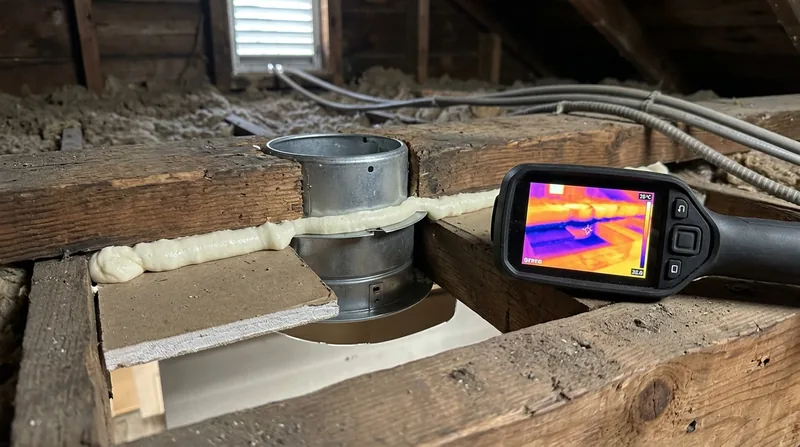




Air sealing in College Station stops the conditioned air from leaking out of your attic, walls, and crawl spaces before it ever reaches the rooms where you live. In the Brazos Valley, homes sit on concrete slabs or pier-and-beam foundations, and above nearly all of them the ductwork and water lines run through a vented attic that hits 140 to 160 degrees Fahrenheit through the long humid summers. That temperature differential, combined with the expansive clay soil and the hard freeze cycles that hit every few years, drives moisture and air movement through gaps, rim joists, and band boards that most homeowners never see. Spray foam air sealing closes those leaks at the source, holding conditioned air in and outside air out. When paired with proper attic spray foam insulation, air sealing is the single most reliable way to flatten your cooling load and stop the seasonal pressure that ages your HVAC system and your house.
Why Air Sealing Matters in College Station's Hot, Humid Climate
The Brazos Valley summer heat is relentless, and most of that cooling energy leaks before it does any work. A home with an open attic, unsealed rim joists, or gaps around ductwork is like trying to cool a room with the door open. In College Station and Bryan, where brick ranches, cottages, and newer two-stories all share the same vented attic problem, the air pressure difference between your inside and outside drives unconditioned air through every crack and penetration. In winter, hard freezes like the 2021 Winter Storm Uri burst water lines in attics and crawl spaces across the valley because the cold air found its way in through the same gaps that let your summer cooling escape. Air sealing stops both problems at once.
- We locate and seal gaps around ductwork, electrical penetrations, and pipe chases that bleed conditioned air into the attic.
- We seal rim joists and band boards on pier-and-beam homes to stop the thermal short-circuit between the crawl space and the conditioned space above.
- We close gaps around attic access panels, pull-down stairs, and soffit returns that turn your attic into an extension of the outdoors.
- We seal wall cavities and injection points in older College Station Victorians and bungalows where the original insulation has settled or failed.
- We use closed-cell or open-cell foam depending on the exposure and the moisture profile of the space, never a one-size-fits-all product.
The result is a tighter home, lower ductwork loss, and a much smaller temperature swing between your attic and your living space, which means your air conditioning runs fewer cycles and your heating does not have to fight a losing battle against infiltration.
Key info: In a typical College Station home with 1,500 to 2,000 square feet of vented attic, air leakage through rim joists, ductwork gaps, and soffit returns can account for 20 to 30 percent of your summer cooling load. A single hard freeze or a humid summer can reveal the exact spots where outside air is entering. We photograph and document every seal point so you know where the work happened.
For more on how insulation works in concert with air sealing, see closed-cell spray foam insulation, which provides both R-value and vapor control in moisture-prone spaces.
How We Perform Air Sealing in College Station Homes and Crawl Spaces
Air sealing is not a spray-and-go operation. We start with a walk-through to identify the leak points that matter most for your home's age, construction type, and exposure. In a 1950s College Station cottage on pier-and-beam, the priority is the rim joist and the crawl space band board. In a newer Southwood Valley two-story with a vaulted bonus room, it is the soffit return, the ductwork chase, and the electrical penetrations around the HVAC closet. We never guess. We seal the places where air actually moves, and we document each one.
- We inspect the attic, crawl space, and walls to map air leakage paths and identify moisture risk before we spray.
- We prep the substrate, remove loose debris and old failed foam, and ensure the surface is clean and dry enough for adhesion.
- We spray closed-cell or open-cell foam to the thickness required for that cavity, with mechanical ventilation running and the spray pattern controlled to avoid over-application.
- We allow the proper cure time, typically 24 to 48 hours, before the space is re-entered or occupied.
- We provide written documentation with R-value and thickness so you and your builder or property manager have proof of the work.
The entire process depends on correct equipment setup, drum temperature, mixing ratio, and pass thickness. A crew that promises immediate re-entry or sprays without ventilation is cutting corners, and the result is a smell that will not go away and foam that never fully cures.
Example: A homeowner in Bryan's Eastside historic district had a 1920s Victorian with an open rim joist and a crawl space that sweated in summer and froze in winter. We sealed the band board with closed-cell foam, sealed the main ductwork chase, and caulked the electrical and plumbing penetrations. The owner saw a 7-degree drop in the upstairs bedroom temperature on the first hot day and no more condensation on the rim joist in January. Total air sealing: three days, one follow-up inspection.
For larger scope work that includes both air sealing and insulation replacement, see insulation replacement and re-insulation.
Air Sealing Methods and Materials
| Approach | Description | Best for |
|---|---|---|
| Closed-Cell Foam Sealing | High-density spray foam that cures to a rigid, vapor-impermeable barrier; R-value 5.5 to 6.5 per inch; stops air and moisture in one pass. | Rim joists, band boards, crawl space walls, and any gap in contact with outdoor air or moisture-prone zones. |
| Open-Cell Foam Sealing | Lower-density foam that cures semi-rigid and vapor-permeable; R-value 3.5 to 3.8 per inch; allows drying if moisture enters. | Interior wall cavities, attic chases, and ductwork penetrations where vapor permeability is an asset and condensation risk is low. |
| Injection Foam Sealing | Low-pressure closed-cell foam injected into existing wall cavities, rim joists, or attic gaps without demolition; fills voids and seals air leaks in place. | 1880s to 1960s College Station homes with frame walls, settled fiberglass, and inaccessible cavities that cannot be re-blown. |
| Caulk and Sealant Finishes | Polyurethane or silicone caulk applied to small gaps, electrical boxes, and trim after foam cures; stops air leakage in tight spaces. | Finishing work around penetrations, soffit returns, and attic access panels where foam would be overkill but gaps still exist. |
Each method is chosen based on the space, the moisture profile, the substrate, and the accessibility. We do not use the same foam in a rim joist as we do in an attic chase, and we do not spray over a wet or contaminated surface. If the substrate is not ready, we walk away and tell you what needs to happen first.
Air Sealing Cost in College Station: What to Expect
Air sealing is priced by the board foot of foam and the linear feet of caulk, plus the scope of access and the complexity of the spaces being sealed. A simple attic chase and soffit return on a single-story College Station cottage might run 50 to 100 board feet and take a single day. A pier-and-beam home with a full rim joist seal, multiple ductwork penetrations, and a crawl space band board can run 200 to 400 board feet and take two to three days. The starting price for most air sealing jobs in College Station is from $650, which covers a basic rim joist seal or a single-story attic chase with caulk finish.
Factors that move the cost up include the linear footage of rim joist or band board to be sealed, the number of ductwork penetrations and electrical chases, the height and accessibility of the attic, the moisture profile of the crawl space, and whether old failed foam needs to be removed first. A home with a wet crawl space or standing water will cost more because we fix the moisture first or we do not spray at all. A 1920s Victorian with inaccessible wall cavities and settled insulation will need injection foam and more time than a newer brick ranch with an open attic.
The best way to know your actual cost is to request a free estimate. We measure the space, identify the leak points, and provide a written quote with R-value and thickness specs before any work begins. Most estimates are completed within 24 hours, and there is no obligation to book. For detailed pricing on other services and to see how air sealing fits into a larger insulation project, visit our full pricing page.
Air Sealing Near Me: What to Look for When Hiring a Contractor in College Station
Not all spray foam contractors are equal, and the difference shows up in the estimate, the equipment, the safety practices, and the follow-up. When you call a contractor for air sealing near College Station, ask for proof of insurance, a written estimate with R-value and thickness, and a reference or two from recent work in your neighborhood. If the estimate has no thickness spec, no R-value, and a price far below market with a promise of same-day re-entry, that is a signal to keep looking. A good contractor will explain what they are sealing, why, and what the cure time is. They will have the right equipment, mechanical ventilation, and a crew that knows the difference between closed-cell and open-cell foam.
- Ask for a written estimate that includes the board feet of foam, the R-value per inch, the thickness per pass, and the linear feet of caulk.
- Verify that the contractor is fully insured and ask to see a current certificate of insurance naming you as additional insured.
- Request references from air sealing or insulation work done in College Station or Bryan in the past 12 months and call at least two.
- Confirm with the City of College Station whether a contractor registration or permit is required for the work at your address.
- Ask about the cure time and the re-entry window; if it is less than 24 hours, ask why the contractor is comfortable with that timeline.
- If you have an HOA or live in a protected historic district like Bryan's Eastside, ask the contractor whether exterior work requires architectural approval before they start.
A contractor who is honest about what they can and cannot do, who documents the work with photos and written specs, and who stands behind their labor for a reasonable warranty period is the one to hire. If you have questions about air sealing or would like to schedule a free estimate, contact us today at (979) 406-5185.
Air Sealing in College Station: Pricing Guide
| Service | Price | Details |
|---|---|---|
| Basic attic air sealing | Starting at $650 | Soffit returns, ductwork chases, and attic access panel sealing on single-story homes with accessible attics. |
| Rim joist and band board sealing | Starting at $900 | Closed-cell foam seal on pier-and-beam homes, priced per linear foot of band board and complexity of crawl space access. |
| Injection foam retrofit sealing | Starting at $1,200 | Injection foam for inaccessible wall cavities, settled insulation, and frame homes built before 1970 without demolition. |
| Multi-area comprehensive air sealing | On estimate | Attic, crawl space, rim joists, walls, and ductwork penetrations combined; scope and moisture profile require on-site measurement. |
| Travel and estimates | Included in College Station area | No mileage fee or travel charge for service areas; free written estimate within 24 hours at (979) 406-5185. |
Indicative pricing, the exact cost depends on square footage, finish, and site access. Free personalized estimate within 24h at (979) 406-5185.


