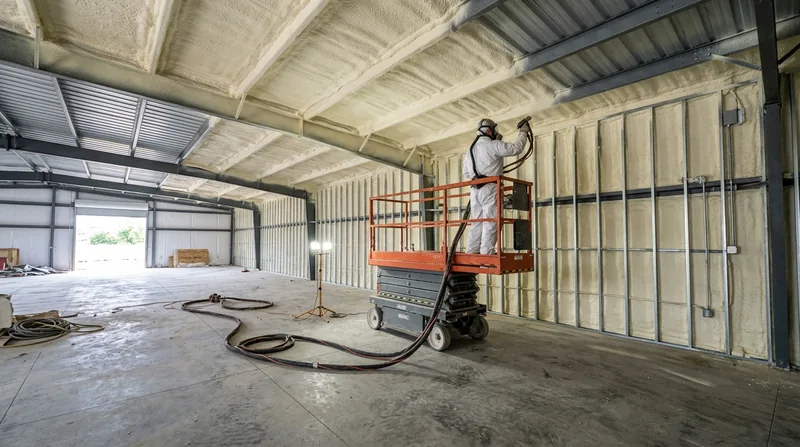




Commercial and new construction spray foam insulation in College Station demands precision, planning, and a contractor who understands both the Brazos Valley climate and the municipal permitting that governs new shells and commercial fit-outs across the region. The summers here run long and humid, with attic temperatures climbing to 140-160°F, and the winters, though mild, snap hard enough to burst water lines, as Winter Storm Uri proved in 2021. Whether you are closing a new metal building near Lake Somerville, insulating a barndominium conversion in Robertson County, or sealing the roof deck of a commercial shell at the Bryan business parks or RELLIS campus, the foam must be applied to code, specified by thickness and R-value, and cured under controlled conditions before re-entry. We have been doing this work since 2012, and we know the code officials, the local terrain, and the particular challenges of spray foam on new construction in this market. Our scope is spray foam insulation and air sealing, attics, walls, crawl spaces, rim and band joists, and commercial shells, and we write estimates with R-value and thickness specs so you know exactly what you are paying for.
Why Commercial and New Construction Spray Foam Matters in the Brazos Valley
New construction in College Station and Bryan moves fast. A developer frames a metal building or a mixed-use commercial shell and needs the envelope closed before the first rain and the first heat. Spray foam does that job in a single day, sealing every penetration, every rim, and every joist pocket in one pass. On a new build, there are no surprises, no old asbestos insulation to navigate, no moisture damage to remediate first. The substrate is clean, the building is dry, and the foam goes on to specification. But that speed only works if the installer knows the code, the equipment, and the local permitting landscape. In College Station and Bryan, attic ventilation rules, ignition barriers, and thermal barriers are governed by the energy and building code in force at your address and by the building official, never by us, and the fifteen-minute thermal barrier distinction is the one most generalists get wrong. A closed cell spray foam installation on a new commercial roof deck or a sealed attic in a new two-story near campus must hit the right R-value, the right thickness, and the right thermal barrier rating, or the permit will not close and your insurance will not cover it.
- We specify R-value and thickness on every estimate so the building official knows exactly what is being installed.
- We manage the mechanical ventilation during cure and enforce a re-entry window so the space is safe and the foam is fully cured before drywall or decking goes on.
- We confirm what your local building department requires before we spray, so there are no surprises at inspection.
- We work with general contractors and developers who are on a schedule and need the job closed on time.
New construction is where spray foam earns its premium, because the thermal performance and the air seal are built into the envelope from day one, and there is no retrofit work, no mess, and no damage to existing finishes.
Key info: The City of College Station and the City of Bryan each enforce their own building codes and require permits for insulation work on commercial and new construction projects. Before any foam is sprayed, we confirm with your local building department which thermal barrier, ignition barrier, and ventilation rules apply at your address. For new commercial shells and barndominiums, this step is not optional, it is the foundation of a clean permit and a passed final inspection.
How We Approach Commercial and New Construction Spray Foam in College Station
Our process is built around getting the foam right the first time, on schedule, and to code. We start with a site walk and a conversation with the general contractor or property manager about the R-value target, the substrate condition, and the local code requirements. We then write an estimate that spells out the foam type, the thickness per pass, the total R-value, and the thermal and ignition barrier details. Once the estimate is signed, we schedule the spray, confirm the weather window and the substrate is dry, and bring our rig to the site. We spray to thickness, manage the cure environment with mechanical ventilation, post the re-entry window clearly, and stay on site until the foam is set. The building official can then inspect with confidence, and the general contractor can move to the next phase without delay.
- We conduct an on-site walk with the GC or property manager to confirm R-value targets and code requirements.
- We write a detailed estimate with R-value, thickness, thermal barrier rating, and local code references.
- We schedule the spray during a weather window when the substrate is dry and ambient temperature is in the manufacturer range.
- We apply the foam in controlled passes, verify thickness with a depth gauge, and manage ventilation during the cure phase.
- We post re-entry windows and provide documentation for the building official and the general contractor.
This approach works for sealed roof decks on new two-stories in College Hills, metal buildings on ranches out past Kurten, barndominiums in Robertson County, and commercial shells at the Bryan business parks. The foam goes on fast, the job closes on schedule, and the building performs from day one.
Example: A new Traditions development townhome near College Station needs a sealed attic with 2-inch closed cell foam for an R-13 minimum and a fifteen-minute thermal barrier. We estimate the job, confirm the code requirement with the City of College Station, spray the foam in one day, manage the cure, and deliver a set of photos and thickness documentation to the builder before the drywall crew arrives. The permit closes clean, and the homeowner gets a conditioned attic from move-in day.
Commercial and New Construction Spray Foam Methods and Foam Types
| Approach | Description | Best for |
|---|---|---|
| Closed Cell Spray Foam | High-density foam with an R-value of 6 to 7 per inch; vapor barrier; moisture resistant; structural rigidity. | Sealed roof decks, metal buildings, barndominiums, commercial shells in humid climates; condensation control on unvented attics. |
| Open Cell Spray Foam | Lower-density foam with an R-value of 3.5 to 3.8 per inch; air seal; sound dampening; moisture permeable. | New construction attics with vented roof decks; interior walls; sound control in commercial spaces. |
| Injection Foam Retrofit | Low-pressure foam injected into closed wall cavities through small holes; no demolition; minimal disruption. | New construction walls before drywall; retrofit of existing frame walls in commercial or residential renovation. |
| Rim and Band Joist Sealing | Closed cell foam applied to the rim joist and band joist of new construction; air seal and thermal break. | New construction on pier-and-beam; crawl space rim sealing; energy code compliance in Brazos Valley homes. |
The choice between closed cell and open cell depends on the use case and the code requirement. On a sealed roof deck or a metal building in the humid Brazos Valley, closed cell is the standard because it resists moisture and provides the structural rigidity needed for unvented attics. On a new vented attic or an interior wall, open cell is often the right answer and costs less. We specify the foam type on every estimate, and we explain why it is the right choice for your building and your code.
Commercial and New Construction Spray Foam Cost in College Station: What to Expect
Commercial and new construction spray foam is priced per board foot of foam applied, measured on site at the time of the spray. The cost depends on the R-value target, the thickness required by code, the size of the area to be insulated, and the complexity of the substrate and the building layout. A small metal building or a new sealed attic on a townhome near campus might run a few hundred board feet; a large commercial shell or a barndominium conversion might run several thousand. We offer a free commercial estimate with R-value and thickness specs so you know the scope and the cost before we schedule the spray. That estimate includes a site walk, a code review, and a written quote with no obligation to book. Travel to College Station and the surrounding service areas is included in our pricing, with no separate mileage or call-out fee.
The primary factors that move the cost are the R-value target set by code or the building spec, the thickness of foam required to hit that R-value, the total square footage of the area to be insulated, and the accessibility of the space. A sealed roof deck on a new two-story near Traditions or Castlegate in College Station will cost more per board foot than a simple attic on a single-story because the deck area is larger and the foam must meet a higher R-value. A metal building on a ranch out past Snook might have a simpler layout and lower cost per square foot, but the total board feet could be substantial because the building is large. We do not quote a price per board foot over the phone, because the only way to know the true scope is to measure and calculate on site. We schedule the estimate within 24 hours of your call to (979) 406-5185, and we deliver the written estimate within one business day. For more detail on our pricing structure and what drives the cost, visit our full pricing overview.
Getting 2 or 3 estimates is smart, because you can compare the R-value, the thickness, the thermal barrier rating, and the total cost. A low-ball estimate with no R-value spec and no thickness detail is a red flag. An estimate with a realistic price, clear specs, and a contractor who can answer your code questions is the one to book.
What to Look for When Hiring a Commercial and New Construction Spray Foam Contractor Near College Station
Hiring the right spray foam contractor for your commercial or new construction project is about more than price. You need a contractor who knows the local code, who can write a detailed estimate, who carries full insurance, and who will show up and finish on schedule. Here is what to verify before you sign a contract.
- Confirm that the contractor is fully insured and ask for a certificate of insurance naming your general contractor or project as additional insured.
- Ask for the contractor's written estimate with R-value, thickness, and thermal barrier rating spelled out in detail.
- Verify that the contractor has worked on commercial and new construction projects in College Station or the Brazos Valley and ask for references you can call.
- Confirm that the contractor will coordinate with your local building department and confirm all code requirements before the spray date.
- Check that the contractor has the right equipment, trained crew, and a track record of on-time, clean jobs.
- Ask about the re-entry window and the ventilation plan during cure, so you know when the space is safe for the next trade.
A local contractor who has been in business for more than a decade, who knows the building officials in College Station and Bryan, and who can reference completed projects in your neighborhood is worth the call. We have worked on new construction and commercial projects across the Brazos Valley since 2012, and we are ready to discuss your project. Call us at (979) 406-5185 or request a free estimate online and we will walk your site and deliver a detailed quote within 24 hours.
Commercial & New Construction Spray Foam in College Station: Pricing Guide
| Service | Price | Details |
|---|---|---|
| Free commercial estimate | Free | On-site walk, code review, written quote with R-value and thickness specs, no obligation to book |
| Sealed roof deck or new attic | Starting at $0.85 per board foot | Closed cell or open cell foam applied to specification, includes mechanical ventilation during cure and re-entry documentation |
| Metal building or large commercial shell | On estimate | Scope determined by R-value target, building size, substrate condition, and code requirements; typically several thousand board feet |
| Rim and band joist sealing | Starting at $0.80 per board foot | Closed cell foam applied to rim and band joists on new construction; air seal and thermal break for crawl space and energy code |
| Travel | Included | College Station, Bryan, Navasota, Brenham, and surrounding service areas; no separate mileage or call-out fee |
Indicative pricing, the exact cost depends on square footage, finish, and site access. Free personalized estimate within 24h at (979) 406-5185.


