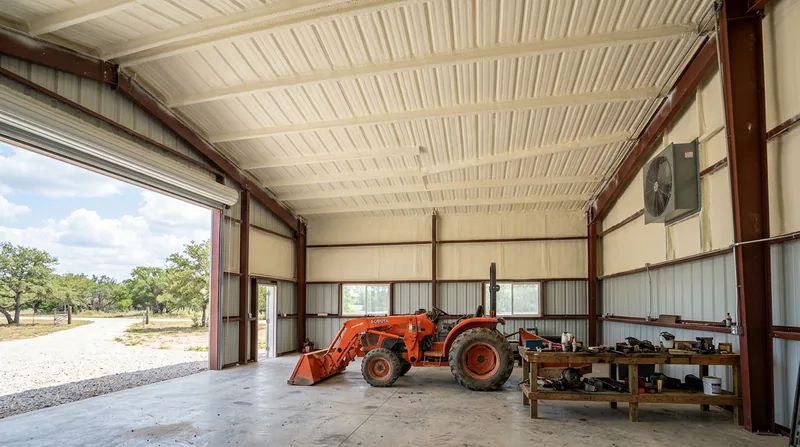




Metal buildings, barndominiums, and agricultural structures across the Brazos Valley face a singular challenge that wood-frame homes do not: steel sweats. When warm, humid air from outside meets an uninsulated metal roof or wall on a cool morning, condensation pools on the underside, dripping onto equipment, hay, stored goods, and living spaces. Metal Building and Barndominium Spray Foam in College Station stops that cycle at the source by sealing the thermal envelope and controlling the moisture gradient. Out past College Station, Bryan, Navasota, and Brenham, where ranches, farm operations, and newer barndominiums dot the post-oak savanna, closed-cell spray foam has become the only reliable defense against rust, mold, and rot. This is not cosmetic work. It is the difference between a structure that lasts and one that corrodes from the inside out.
Why Metal Building and Barndominium Spray Foam Matters in the Brazos Valley
The Brazos Valley climate and the nature of metal construction create conditions that fiberglass batts, blown-in cellulose, and traditional ventilation cannot solve. Steel conducts temperature rapidly. When the sun sets and the metal cools, the air trapped beneath it reaches dew point. Without a vapor barrier and thermal break, that moisture condenses directly on the steel, running down walls and pooling on rim joists and band joists. Over months and years, rust develops, fasteners corrode, and the structural integrity of the building begins to fail. Closed-cell spray foam adheres directly to steel, creating both an air seal and a continuous vapor barrier that stops moisture migration before it starts.
- Closed-cell foam bonds to metal without fasteners, eliminating thermal bridging through attachment points.
- The foam itself is a vapor barrier, so no separate membrane is required between the insulation and the steel.
- The R-value of closed-cell foam (typically R-6 to R-7 per inch) means thinner coverage achieves high performance in tight spaces.
- Spray foam conforms to curved roofs, irregular framing, and corrugated panels without gaps or voids.
- The sealed envelope reduces the load on HVAC equipment and prevents the smell and mold growth that come with moisture buildup.
For barndominiums and metal buildings used as workshops, storage, or mixed-use structures across Grimes, Burleson, Robertson, and Washington County, this performance is not optional. It is the baseline.
Key info: A 40-foot by 60-foot metal barn in Somerville with a condensation problem can lose thousands of dollars in equipment and inventory damage annually. Closed-cell spray foam applied to the underside of the roof deck and the interior walls typically costs between $2.50 and $3.50 per square foot, depending on thickness and access, and eliminates the problem for the life of the building.
How We Insulate Metal Buildings and Barndominiums in College Station and Surrounding Areas
The process begins with a walk-through to assess the current condition of the metal structure, identify any existing moisture damage or rust, and determine whether the substrate is dry and suitable for foam application. We measure the square footage of roof deck, walls, and any rim or band joists that need coverage. We then discuss the R-value target, the thickness required to achieve it, and the type of foam (closed-cell for moisture control and maximum performance, or open-cell if the budget is tighter and the application does not require vapor control). Once the scope is locked, we schedule the work and prepare the site.
- We inspect the metal structure for rust, corrosion, or active leaks and defer work until the substrate is dry and sound.
- We set up mechanical ventilation inside the building to manage off-gassing during the spray and cure process.
- We apply closed-cell or open-cell foam in multiple passes, controlling thickness and ratio to meet specification.
- We allow the foam to cure fully (typically 24 to 48 hours) before the building is re-occupied or equipment is stored inside.
- We inspect the finished work for coverage, thickness, and adherence, and we provide written documentation of R-value and board-foot volume.
A typical 2,400-square-foot metal building roof deck insulated to R-30 with 5 inches of closed-cell foam takes two to three days from setup to full cure.
Local example: A barndominium in Caldwell with a 1,800-square-foot vaulted ceiling and an open floor plan used for both living and equipment storage needed closed-cell foam to R-25 on the roof deck and R-19 on the gable walls. The job took three days, cost approximately $4,200 to $5,100, and eliminated condensation and odor issues that had made the space uncomfortable during humid months.
Closed-Cell and Open-Cell Foam for Metal Buildings: Methods and Applications
| Approach | Description | Best for |
|---|---|---|
| Closed-Cell Spray Foam on Roof Deck | High-density foam (typically 2 lbs/cubic foot) sprayed to 4 to 6 inches, creating R-24 to R-36 and a complete vapor barrier. | Metal barns, agricultural buildings, and barndominiums where condensation control is the primary concern. |
| Closed-Cell Spray Foam on Walls and Rim Joists | Same density and R-value as roof application, conforming to corrugated panels, metal studs, and irregular framing. | Perimeter insulation on metal buildings and protection of rim band joists on hybrid structures (metal frame, wood floor). |
| Open-Cell Spray Foam for Sound Dampening | Low-density foam (0.5 lbs/cubic foot) sprayed to 5 to 7 inches, achieving R-19 to R-25 and absorbing sound from metal rattle and rain. | Interior spaces where noise reduction matters and moisture is not a concern, such as workshop ceilings or office areas inside a metal shell. |
| Retrofit Foam Over Existing Insulation | Closed-cell foam applied to the underside of failing or inadequate fiberglass or blown-in insulation to upgrade R-value and seal gaps. | Older metal buildings where the original insulation has settled, degraded, or failed to control condensation. |
Closed-cell foam is the standard for metal buildings in the Brazos Valley because it solves the condensation problem and provides the highest R-value per inch in a thin package. Open-cell foam is used when budget is the primary driver and the application does not require vapor control, such as an interior workshop ceiling or a non-climate-controlled storage loft.
Metal Building and Barndominium Spray Foam Cost in College Station: What to Expect
Pricing for metal building and barndominium spray foam in College Station depends on the size of the structure, the R-value target, the type of foam, and the accessibility of the roof deck and walls. Closed-cell foam typically runs from $2.50 to $3.50 per square foot of coverage, while open-cell foam is generally $1.50 to $2.25 per square foot. These figures assume standard access (ground-level work, ladders, or a lift) and straightforward geometry such as a rectangular roof deck or flat walls.
A 2,400-square-foot metal barn roof insulated to R-30 with 5 inches of closed-cell foam would cost approximately $6,000 to $8,400 before travel. A 1,200-square-foot barndominium loft with open-cell foam to R-19 would run $1,800 to $2,700. Factors that increase cost include steep or complex roof pitches, limited roof access requiring specialized equipment, existing moisture damage that must be dried or cleaned before foam application, and removal of old insulation or debris.
We provide written estimates that specify the R-value, the thickness of foam in inches, the total board-foot volume, and the cost per square foot. This transparency allows you to compare quotes and understand exactly what you are paying for. For a detailed breakdown and a free estimate for your specific building, visit our pricing page or call us at (979) 406-5185.
What to Look for When Hiring a Spray Foam Insulation Contractor Near College Station
Not all spray foam installers are equal. The difference between a competent crew and a rig-and-run operation shows up in the estimate, the installation process, and the durability of the result. When you are evaluating contractors for metal building and barndominium spray foam near College Station, ask the right questions and verify the answers.
- Request a written estimate that includes the R-value, the thickness in inches, the square footage, the board-foot volume, and the cost per square foot, never a vague total without detail.
- Ask whether the contractor will use mechanical ventilation during the spray and cure, and confirm the re-entry window (typically 24 to 48 hours) before the building is occupied.
- Verify that the contractor is fully insured and ask for a certificate of insurance naming your building as an additional insured during the work.
- Check references from at least two previous metal building or barndominium jobs in the area, and ask those customers about condensation control and long-term performance.
- Confirm that any permits required by the City of College Station, Bryan, or the county are understood and will be pulled before work begins.
A reputable contractor will not promise immediate re-entry, will not spray foam over wet or contaminated metal, and will walk away if the substrate is not suitable. These are signs of professionalism, not hesitation. For a consultation and a no-obligation estimate, contact us today.
Metal Building & Barndominium Spray Foam in College Station: Pricing Guide
| Service | Price | Details |
|---|---|---|
| Closed-Cell Spray Foam (Metal Roof Deck) | Starting at $2.50/sq ft | R-24 to R-36 with 4 to 6 inches; vapor barrier included; condensation control for metal structures |
| Closed-Cell Spray Foam (Walls and Rim Joists) | Starting at $2.75/sq ft | Same R-value as roof; conforms to corrugated panels and irregular metal framing; full vapor seal |
| Open-Cell Spray Foam (Interior Spaces) | Starting at $1.50/sq ft | R-19 to R-25 with 5 to 7 inches; sound dampening; lower cost option for non-critical moisture zones |
| Retrofit Over Existing Insulation | On estimate | Depends on depth and condition of old insulation; removal may be required; site inspection needed |
| Travel and Site Prep | Included | No additional mileage fee in College Station and surrounding Brazos Valley service areas |
| Free Written Estimate | No obligation | Response within 24 hours; R-value, thickness, and board-foot volume specified; call (979) 406-5185 |
Indicative pricing, the exact cost depends on square footage, finish, and site access. Free personalized estimate within 24h at (979) 406-5185.


