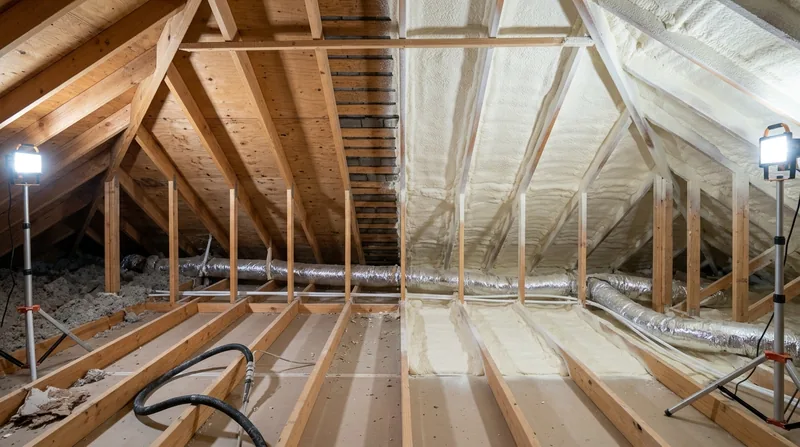




College Station and Bryan sit in the Brazos Valley where summer heat climbs to 140-160°F in vented attics, and the humid subtropical climate puts constant pressure on insulation systems. Homes here sit on concrete slabs or pier-and-beam foundations, with ductwork and water lines running through attics that were often filled decades ago with fiberglass batts, blown cellulose, or mineral wool that has settled, compacted, or failed entirely. Insulation Replacement & Re-Insulation in College Station is not cosmetic work. It is the difference between an attic that leaks conditioned air and one that holds it, between water pipes that freeze in winter and ones that stay protected, and between energy bills that rise every summer and ones that stabilize. Whether you live in a 1940s bungalow near downtown Bryan, a brick ranch on the Eastside, a student duplex near campus, or a newer two-story in Southwood Valley, old or failed insulation is costing you money every month. We remove what is not working, seal the air leaks around it, and install spray foam insulation that will not settle, compress, or lose R-value over time.
Why Insulation Replacement Matters in College Station: The Cost of Delay
Failed insulation in the Brazos Valley is not a slow fade. The heat gain through a deteriorated attic in July costs you real money every single day, and water pipes that freeze in winter storms like Uri in 2021 can burst and flood a home in hours. Homes built in the 1950s through 1980s often have original fiberglass that has settled into the bottom third of the rafter bay, leaving the top two-thirds open to the attic air. Blown cellulose absorbs moisture in our humid summers and loses R-value as it settles. Mineral wool and rockwool batts come loose and fall into the joist spaces. When you replace that failed insulation with spray foam, you seal the air leaks at the same time, you get consistent R-value from day one, and you protect the mechanical systems that run through your attic.
- Settled fiberglass batts leave gaps that leak air directly into your living space, raising cooling costs by 20 to 30 percent in summer.
- Moisture-damaged cellulose loses R-value and can support mold growth if not addressed before new insulation is installed.
- Water pipes running through a vented attic freeze when outdoor temperatures drop below 32°F, and burst pipes flood attics and ceilings.
- Spray foam replacement seals the thermal boundary and the air barrier at the same time, so you do not pay for both separately.
- Once installed, spray foam does not settle, compress, or degrade over decades, so your R-value stays constant.
Replacing failed insulation is not optional in the Brazos Valley. It is the single most effective way to stabilize your energy bills and protect your home.
Key info: Winter Storm Uri in 2021 burst water lines across College Station and Bryan because attic temperatures dropped below freezing and the original fiberglass insulation had settled so far that pipes were exposed. Replacing that insulation with closed-cell spray foam would have kept the attic warm enough to prevent freezing.
How Insulation Replacement & Re-Insulation Works in College Station
The process starts with a walkthrough of your attic, crawl space, or walls to assess what is there, what is failing, and what needs to come out. We measure the area, identify air leaks around electrical penetrations, pipe chases, and the rim joist, and we write a scope that specifies the R-value you need and the thickness of foam we will install to achieve it. We remove all failed insulation, vacuum out dust and debris, seal the air leaks with foam or caulk, and then spray the new foam at the correct ratio and temperature so it cures properly. You get a written estimate with R-value and thickness specs before we schedule work, and we coordinate with any permits your city requires. See our detailed guide to attic spray foam insulation for the specifics of how we handle vented attics and sealed roof decks.
- We inspect your attic, crawl space, or walls and identify all failed or inadequate insulation before giving you a number.
- We remove all old insulation, batts, blown-in material, and debris, leaving a clean substrate for the new foam.
- We seal air leaks around electrical boxes, pipe penetrations, rim joists, and band joists so conditioned air does not escape.
- We spray closed-cell or open-cell foam at the manufacturer ratio and temperature, with mechanical ventilation during cure.
- We specify R-value and thickness in writing so you know exactly what you are getting and why.
- We coordinate with your city's building department if a permit is required at your address.
The entire process is transparent. You see what we remove, you see what we install, and you have a written record of the R-value and thickness so you can verify the work was done as promised.
Example: A 1960s brick ranch in College Hills had R-11 fiberglass batts that had settled to R-4 or R-5 over fifty years. We removed all of it, sealed the air leaks around the electrical panel and the rim joist, sprayed 5.5 inches of closed-cell foam to achieve R-38, and the homeowner's summer cooling bills dropped by 18 percent in the first month.
Methods and Materials for Insulation Replacement & Re-Insulation
| Approach | Description | Best for |
|---|---|---|
| Closed-cell spray foam | High-density foam at 1.5 to 2 pounds per cubic foot, R-6 to R-7 per inch, provides air seal and vapor barrier. | Attics with water lines or HVAC ducts, crawl spaces with moisture risk, metal buildings and barndominiums subject to condensation. |
| Open-cell spray foam | Low-density foam at 0.5 pounds per cubic foot, R-3.5 per inch, vapor permeable, lower cost than closed-cell. | Attics in dry climates where moisture is not a concern, interior walls for sound dampening, homeowners on a tighter budget. |
| Wall and injection foam | Closed-cell foam injected into cavity walls without removing drywall, fills voids and seals air leaks in place. | 1920s to 1970s homes with hollow walls, retrofit insulation without demolition, improving comfort in cold rooms. |
| Rim and band joist sealing | Spray foam applied to exposed rim joists and band joists on pier-and-beam homes, seals the junction between foundation and framing. | College Station and Bryan pier-and-beam homes, crawl space air sealing, protection of water pipes in winter. |
Insulation Replacement & Re-Insulation Cost in College Station: What to Expect
The cost of replacing failed insulation depends on the area you need to cover, what type of foam you choose, and how much air sealing is required. A typical attic replacement in a College Station home starts at $2,800 for a modest square footage with straightforward access and standard R-value specs. Larger homes, complex roof lines, crawl spaces, or wall injection work will cost more. The best way to understand your cost is to request a free written estimate that specifies the R-value, thickness, and square footage so you can compare apples to apples. Visit our pricing page for more detail on what drives costs up or down.
Several factors move the price: the total square footage of the area, whether you choose closed-cell or open-cell foam, the R-value target, air sealing scope around electrical and mechanical penetrations, and whether existing insulation must be removed. A crawl space on a pier-and-beam home costs more than an attic because of the height and the moisture risk. Wall injection in a 1950s frame home costs more per square foot than attic spray because of the precision required and the number of injection points. We do not charge travel fees in College Station and the surrounding area, and we respond to estimate requests within 24 hours at (979) 406-5185.
Getting two or three estimates from different contractors is smart. Make sure each one specifies R-value and thickness in writing, explains why they chose that R-value for your climate, and tells you whether they will remove old insulation or spray over it. A price far below market with no written specs and no removal plan is a red flag.
What to Look for When Hiring a Spray Foam Insulation Contractor Near Me in College Station
Hiring the right contractor for insulation replacement is about more than price. You want someone who will remove failed insulation properly, seal air leaks correctly, and install foam at the right ratio and temperature so it cures and performs as promised. In College Station and Bryan, contractor registration varies by city, so start by asking your contractor whether they are registered with your city and asking your city's building department to confirm it before any work begins. Request a written estimate that includes R-value, thickness, and square footage. Ask for references from recent jobs in your neighborhood. Ask whether they carry full insurance and whether they will coordinate with your city on any required permits.
- Request a written estimate that specifies R-value, thickness, and the total square footage so you can verify the work was done as promised.
- Ask whether the contractor is registered with your city and confirm that registration with your city's building department before signing.
- Ask for at least two references from recent insulation replacement jobs in College Station or Bryan, and call them.
- Confirm that the contractor carries full insurance and ask for a certificate of insurance before work begins.
- Ask whether they will remove all old insulation or spray over it, and why, so you understand the approach.
- Verify that the estimate includes mechanical ventilation during cure and a re-entry window of 24 to 48 hours before you occupy the space.
- Get a timeline for the work and ask what happens if weather or access issues delay the job.
The contractor you hire should be able to answer every one of these questions clearly and in writing. If they cannot, or if they promise a price far below market with no inspection, that is a sign to call someone else. Contact us at College Station Spray Foam Insulation for a free estimate with full specs, or call (979) 406-5185 to discuss your specific situation.
Insulation Replacement & Re-Insulation in College Station: Pricing Guide
| Service | Price | Details |
|---|---|---|
| Attic insulation replacement, standard home | Starting at $2,800 | Removal of failed insulation, air sealing, and closed-cell foam to R-38 in 1,200 to 1,600 square feet |
| Crawl space insulation and air sealing | Starting at $3,200 | Removal and replacement, rim joist and band joist sealing, closed-cell foam on 600 to 800 square feet of pier-and-beam foundation |
| Wall and injection foam retrofit | Starting at $1,400 | Closed-cell foam injected into cavity walls without demolition, typical cost for 300 to 400 linear feet of exterior wall |
| Large or complex job | On estimate | Multi-area replacement, sealed roof decks, extensive air sealing, or specialty applications require on-site inspection for accurate pricing |
| Travel and service call | Included | No separate mileage or travel fee in College Station, Bryan, and surrounding service areas within 20 miles |
| Free written estimate | No obligation | Response within 24 hours, full R-value and thickness specifications included, no charge to request or review |
Indicative pricing, the exact cost depends on square footage, finish, and site access. Free personalized estimate within 24h at (979) 406-5185.


