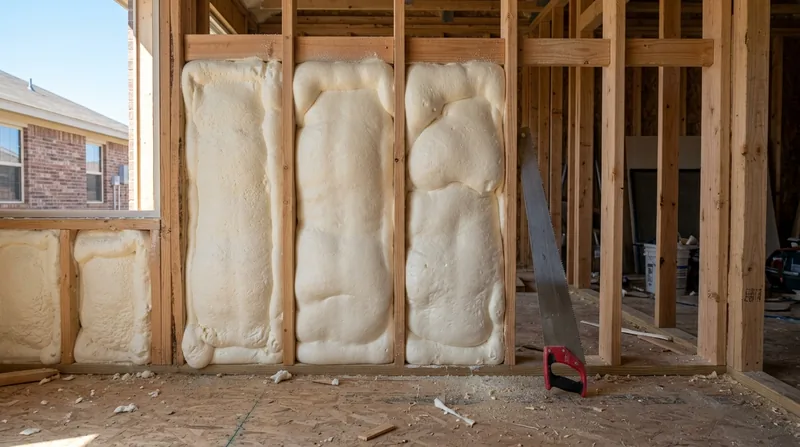




Open Cell Spray Foam Insulation in College Station addresses the core thermal and moisture challenge of the Brazos Valley: vented attics that climb to 140-160°F through long humid summers, with ductwork and water lines running through air that leaks constantly into living spaces below. College Station sits on rolling post-oak savanna with expansive clay soils, and most homes rest on concrete slabs or pier-and-beam foundations with no basements. The attic above is where energy escapes and where humidity condenses on cold water lines during winter freeze events like the 2021 Winter Storm Uri that burst lines across the valley. Open cell foam seals that attic envelope, dampens sound in bonus rooms and vaulted spaces common in the 1980s-2020s brick two-stories near campus, and costs less per board foot than closed cell, making it the right choice for many retrofit jobs where moisture control is secondary to air sealing and thermal resistance.
Why Open Cell Spray Foam Insulation Matters in College Station's Hot, Humid Climate
The Brazos Valley summer is relentless: attic temperatures exceed 155°F for weeks at a time, and that heat radiates downward through standard fiberglass batts and blown-in cellulose into rooms below, forcing air conditioning to run harder and longer. Humidity is equally punishing. Water lines running through vented attics sweat in summer and freeze in winter, and when a hard freeze hits, those lines burst without fail. Vented attics also leak air continuously around ductwork penetrations, light fixtures, and chase walls, which means conditioned air escapes and unconditioned air enters. Open cell foam solves all three problems at once: it seals air leaks, it insulates to a solid R-value, and it does both for roughly 40 to 50 percent less than closed cell spray foam.
- Seals every air leak around ductwork, electrical chases, and attic penetrations that fiberglass and cellulose leave open.
- Reaches R-value 3.6 to 3.8 per inch depending on thickness, delivering solid thermal resistance in a single application.
- Allows vapor transmission, so moisture in the attic can migrate back out rather than trapping water in fiberglass batts.
- Dampens sound in bonus rooms, vaulted ceilings, and garage ceilings common in College Station residential stock from the 1980s forward.
- Costs significantly less per board foot than closed cell, making it the economical retrofit choice for sound attics that do not require moisture barrier performance.
Open cell foam is the standard retrofit insulation for the majority of College Station attics where the goal is thermal improvement and air sealing without the premium cost of closed cell.
Key info: Winter Storm Uri in 2021 burst water lines across the Brazos Valley, and many homeowners replaced burst lines but left the attic uninsulated. Open cell foam seals the air leaks that allowed freezing air to reach those lines in the first place, and it costs half what closed cell does. If your water lines froze in 2021, your attic is still vented and leaking.
How We Install Open Cell Spray Foam Insulation in College Station Attics
Open cell spray foam installation starts with a detailed attic inspection to map ductwork, electrical chases, and existing insulation. We then remove any failed or contaminated insulation (a separate but necessary step in retrofit work), seal the attic rim with caulk or foam backer rod, and spray open cell foam in controlled passes to the specified R-value and thickness. The foam expands as it cures, filling every corner and sealing air leaks around penetrations that blown-in insulation cannot reach. We maintain mechanical ventilation during cure to manage off-gassing, and we provide a re-entry window of 24 to 48 hours before the space is occupied again. The result is a sealed, insulated attic that holds conditioned air inside and keeps heat and humidity outside.
- We inspect the attic, identify ductwork and electrical penetrations, and confirm the substrate is clean and dry.
- We remove any existing failed fiberglass or cellulose insulation if present, hauling it away and disposing of it properly.
- We seal rim board and band joist air leaks with caulk or foam backer rod before spraying the main attic floor.
- We spray open cell foam in controlled passes to your specified R-value and thickness, as documented on your written estimate.
- We maintain mechanical ventilation during cure and provide a clear re-entry timeline before your family returns to the home.
Every open cell installation in College Station includes a written estimate with R-value and thickness specifications so you know exactly what you are paying for and what thermal performance you will receive. We also handle air sealing around the foam to capture leaks that foam alone cannot reach.
Example: A 1960s brick ranch in College Station's Southside with original flattened attic insulation and exposed ductwork needed R-38 in the attic. We removed the aged fiberglass, sprayed 10.5 inches of open cell foam at R-3.7 per inch, sealed the rim and ductwork penetrations, and reduced the homeowner's summer cooling load by an estimated 18 to 25 percent. Cost was roughly half of what closed cell would have been.
| Approach | Description | Best for |
|---|---|---|
| Open Cell Spray Foam Retrofit | Remove failed insulation, spray open cell foam to R-38 or R-49, seal rim and ductwork penetrations. | Sound attics with no moisture intrusion, maximum thermal and acoustic benefit per dollar. |
| Open Cell Top-Up | Spray 3 to 6 inches of open cell foam over existing fiberglass or cellulose to reach target R-value. | Attics with adequate existing insulation that need a thermal boost without full removal. |
| Open Cell Bonus Room or Garage Ceiling | Spray open cell foam against the roof deck to insulate and dampen sound in finished or semi-finished space. | Finished bonus rooms, vaulted ceilings, and garage ceilings in 1980s-2020s residential stock. |
| Open Cell with Sealed Attic | Spray open cell foam against roof deck and seal soffit vents to create an unvented, conditioned attic. | Homes with HVAC equipment or ductwork in the attic that benefit from a fully conditioned space. |
Open Cell Spray Foam Insulation Cost in College Station: What to Expect
Open cell spray foam insulation in College Station typically runs starting at $0.55 per board foot, which means a 1,000-board-foot attic retrofit (roughly 10 inches of foam over 1,200 square feet) will fall in the $550 to $750 range before removal and disposal of existing insulation. The final price depends on attic size, existing insulation condition, accessibility, and whether you need insulation removal and rim board air sealing. College Station attics average 1,200 to 1,600 square feet, so most retrofit jobs land between $800 and $1,200 fully installed with removal included. Closed cell spray foam costs roughly two to three times as much per board foot but is necessary only if your attic has moisture intrusion or if you need a vapor barrier. If your attic is dry and your goal is thermal improvement and sound dampening, open cell is the right economic choice.
We provide a free written estimate with R-value and thickness specifications so you know exactly what the job will cost and what thermal performance you will receive. Most estimates are ready within 24 hours of your call to (979) 406-5185. Factors that affect the final price include attic size, height of existing insulation, accessibility for equipment, and whether removal of failed fiberglass or cellulose is required. We also charge no travel fee within College Station and surrounding areas, so the estimate you receive is the cost of the work itself.
For detailed pricing across all our services, including seasonal variations and volume discounts, visit our pricing page.
What to Look for When Hiring an Open Cell Spray Foam Contractor Near Me in College Station
Spray foam installation is not licensed at the state level in Texas, but many cities in the College Station area, including College Station itself, require contractor registration before any work begins. Before you hire any spray foam contractor, confirm what registration or licensing your city requires and ask the contractor to provide proof of registration or a certificate of good standing from your local building department. Equally important: verify that the contractor carries full liability insurance and can provide a current certificate of insurance naming you as additional insured. Get at least two to three written estimates that include R-value, thickness, and board-foot calculations so you can compare apples to apples. Ask about the contractor's process for managing off-gassing during cure and what re-entry timeline they guarantee. Avoid any contractor who promises immediate re-entry, offers a price far below market with no inspection, or cannot explain the difference between open cell and closed cell foam in terms of your specific use case.
- Ask your contractor to confirm what registration or licensing your city requires and to provide proof before work begins.
- Request a current certificate of insurance that shows general liability coverage and names you as additional insured.
- Get written estimates from at least two contractors that specify R-value, thickness, board footage, and total cost.
- Ask about mechanical ventilation during cure and the re-entry window before the space is occupied again.
- Confirm that any removal of existing insulation is included in the estimate and that disposal is handled by the contractor.
- Check references from recent jobs in College Station or nearby towns like Bryan, Navasota, or Brenham.
The local independent spray foam contractor has a real advantage over out-of-state rigs and national franchises: we answer the phone when you call after the job is done, we stand behind our work with a warranty, and we know the local building codes and the specific moisture and temperature challenges of the Brazos Valley. Contact us for a free estimate and we will walk you through the process step by step.
Open Cell Spray Foam Insulation in College Station: Pricing Guide
| Service | Price | Details |
|---|---|---|
| Open Cell Spray Foam Retrofit (Standard Attic) | Starting at $0.55/board ft | Includes removal of existing insulation, foam application to specified R-value, rim sealing, and debris disposal for typical 1,200-1,600 sq ft attics |
| Open Cell Top-Up (Over Existing Insulation) | Starting at $0.55/board ft | Spray 3 to 6 inches of open cell foam over sound fiberglass or cellulose to boost R-value without full removal, lower labor cost |
| Open Cell Bonus Room or Garage Ceiling | Starting at $0.65/board ft | Spray open cell against roof deck in finished spaces or garage ceilings for insulation and sound dampening, includes foam and labor |
| Open Cell Sealed Attic (Unvented) | Starting at $0.70/board ft | Spray open cell against roof deck and seal soffit vents to create conditioned attic space, includes removal, foam, and soffit sealing |
| Complex or Large-Scale Job | On estimate | Multi-building projects, barndominiums, metal buildings, or jobs requiring extensive air sealing and custom moisture assessment |
| Free Estimate | No charge | Written estimate with R-value and thickness specs, response within 24 hours, no obligation to book, call (979) 406-5185 |
Indicative pricing, the exact cost depends on square footage, finish, and site access. Free personalized estimate within 24h at (979) 406-5185.


