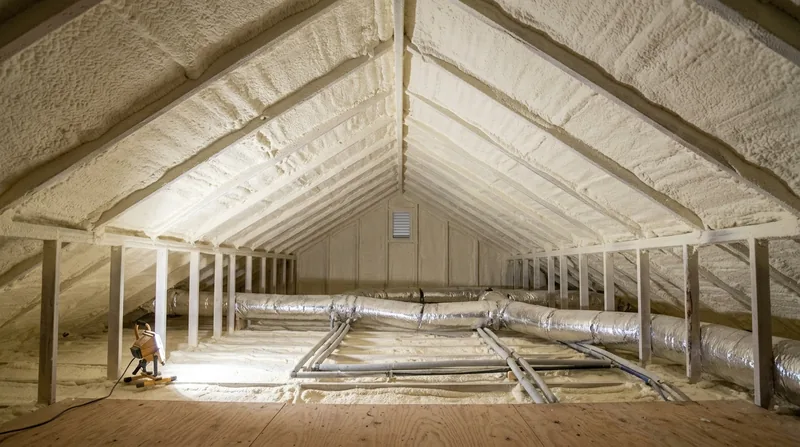




College Station summers push attic temperatures to 140 to 160 degrees Fahrenheit, and the ductwork running through your vented attic loses conditioned air every day that heat climbs. The post-oak savanna terrain and expansive clay soils that underlie the Brazos Valley mean most homes here sit on concrete slabs or pier-and-beam foundations with no basements, which puts all the thermal load on the attic above. Whether you own a brick ranch on the Southside, a 1940s cottage near campus, a newer two-story in Castlegate or Southwood Valley, or a historic Victorian in Bryan's Eastside, attic spray foam insulation is the most direct way to stop that heat leak and bring your cooling costs under control. We have been spraying attics and sealing air leaks across the Brazos Valley since 2012, and we approach every job with written estimates that spell out R-value and thickness, not guesswork.
Why Attic Spray Foam Insulation Matters in College Station and Bryan
Your attic is not a dead space. In the summer it becomes a radiant oven that forces your air conditioning unit to run longer and harder to overcome the heat load bleeding through the ceiling below. Fiberglass batts and blown-in fiberglass lose R-value when air moves through them, and the gaps around ductwork, electrical penetrations, and band joists let conditioned air escape before it even reaches your living space. Spray foam seals those leaks at the source and does not degrade when humid air cycles through the attic. In winter, when a hard freeze comes (like Winter Storm Uri in 2021), proper attic insulation and air sealing protect the water lines that run through many attics here, and they keep the attic temperature closer to the home temperature so condensation does not form on the underside of the roof deck.
- Spray foam stops air leakage around ductwork, electrical chases, and soffit returns that fiberglass cannot seal.
- A sealed or unvented attic with closed-cell foam keeps the attic temperature closer to indoor conditions, protecting pipes and reducing thermal cycling stress.
- Open-cell foam in an attic with proper ventilation offers lower cost and still delivers strong R-value without the moisture risk of dense packing.
- Air sealing the attic reduces the load on your HVAC system and cuts the number of hours the unit runs during the cooling season.
Getting the attic right is the single largest payoff in the energy performance of a College Station home.
Key info: College Station and Bryan building codes require either ventilation of the attic space or compliance with a sealed attic standard. The local building department sets the rule, not the insulation crew. Always ask your contractor what applies at your address and confirm it with the City of College Station or City of Bryan building division before work begins. Our written estimates name the approach and the code section so you know exactly what you are getting.
For more detail on the closed-cell option and its R-value performance, see our closed-cell spray foam insulation page.
How We Spray Foam Your Attic: The Process from Start to Finish
Attic spray foam work starts with a clear picture of what you have now and what needs to change. We inspect the attic for existing insulation type and condition, identify all the air leaks (rim joists, ductwork seams, electrical chases, soffit vents, plumbing penetrations), measure the square footage, and note any moisture damage, roof leaks, or contamination that must be addressed before we spray. If the attic has failed fiberglass or old blown-in that is matted down or contaminated, we remove it first and haul it away. Then we seal the air leaks with foam, spray the roof deck or attic floor to the thickness and R-value your estimate specifies, and ensure proper ventilation (if required by code) or a sealed deck (if that is the path). The whole job runs mechanical ventilation during cure to manage VOCs, and we set a re-entry window of 24 to 48 hours depending on foam type and weather.
- We inspect your attic and identify all air leak points, existing insulation condition, and any moisture or roof damage that must be corrected first.
- We remove failed or contaminated insulation and haul it away if your attic needs it.
- We seal rim joists, band joists, ductwork, electrical chases, and soffit vents with foam or gasket tape.
- We spray the attic floor or roof deck to the R-value and thickness specified in your written estimate.
- We run mechanical ventilation during cure and provide a clear re-entry timeline so you know when the attic is safe to enter.
The result is an attic that does not leak conditioned air and that stays closer to your home temperature year-round.
Example: A 1970s brick ranch in College Hills with original fiberglass batts that have settled and separated from the rim joists might have an attic that is 15 to 20 degrees hotter than the living space below on a summer afternoon. After spray foam on the rim joists and a top-up of open-cell foam over the attic floor, that temperature difference drops to 5 to 8 degrees, and the air conditioning unit cycles less often. The homeowner sees the difference in comfort and in the utility bill within the first month.
To understand the difference between open-cell and closed-cell, and which is right for your attic, visit our open-cell spray foam page.
Attic Spray Foam Methods and Approaches
| Approach | Description | Best for |
|---|---|---|
| Open-Cell Spray Foam | Low-density foam (0.5 to 1.5 pcf) sprayed to 5.5 to 6.5 inches for R-value of 19 to 23 per inch. Breathable, softer, easier to cut and patch. Lower cost than closed-cell. | Vented attics in College Station and Bryan where moisture control is handled by ventilation. Retrofit jobs on a budget. Sound dampening in bonus rooms over garages. |
| Closed-Cell Spray Foam | High-density foam (1.5 to 2.0 pcf) sprayed to 2 to 3 inches for R-value of 6 to 7 per inch. Rigid, air-impermeable, vapor barrier, moisture resistant. Higher cost but smaller thickness. | Sealed attics and unvented roof decks. Attics with moisture risk or difficult access. Metal buildings and barndominiums where condensation control is critical. |
| Rim and Band Joist Sealing | Spray foam applied to the rim joist and band board where the house frame sits on the foundation. Seals the biggest single air leak in most homes. Can be open-cell or closed-cell depending on access and moisture. | Pier-and-beam homes in the Brazos Valley. Historic cottages and bungalows in Bryan and Navasota. Any home where the attic air is leaking down into the crawl space or living space. |
| Insulation Removal and Replacement | Complete removal of failed, matted, or contaminated fiberglass or blown-in, followed by spray foam or blown-in replacement. Includes disposal and haul-away. | Attics with 30+ years of settled batts, previous water damage, or rodent contamination. Retrofit jobs where the old insulation is no longer performing. |
Attic Spray Foam Insulation Cost in College Station: What to Expect
Attic spray foam insulation typically starts at $1.50 per square foot for open-cell foam in a straightforward job with good access and no existing insulation removal. Closed-cell foam costs more per square foot because the material is denser and the labor is more precise, but it requires less thickness to reach the same R-value. The actual cost for your attic depends on the square footage of the space, the R-value target, whether you need insulation removal first, the complexity of the air sealing (how many ductwork seams, electrical chases, and soffit vents need to be sealed), and the ease of access to the attic.
A 1,200-square-foot attic with good access and no removal needed might run $1,800 to $2,400 for open-cell to R-38. The same attic with 2 inches of closed-cell foam might run $2,400 to $3,200. If the attic has old fiberglass that must be removed first, add $400 to $800 for removal and haul-away. Getting two or three written estimates with R-value and thickness spelled out is always worth the time, because the difference in price and approach can be substantial, and you will know exactly what you are paying for.
See our full pricing overview for more detail on what moves the cost up or down.
What to Look for When Hiring a Spray Foam Insulation Contractor Near College Station
The spray foam market in College Station, Bryan, and the Brazos Valley includes local shops, national franchises, and out-of-state crews that show up, spray fast, and disappear. The difference between a good installation and a bad one shows up weeks or months later when the smell does not fade, the foam shrinks or cracks, or the air sealing does not hold. Here is how to protect yourself when you call a contractor.
- Ask any contractor for a written estimate that includes R-value, thickness in inches, square footage, foam type (open-cell or closed-cell), and the cost broken down by line item.
- Verify that the contractor is fully insured and ask to see a current certificate of insurance naming the insurer and the coverage limits.
- Check that the contractor is registered as a contractor with the City of College Station, City of Bryan, or whichever municipality covers your address, and confirm the registration with the city before work begins.
- Ask for references from jobs done in the last two years and call at least two to ask about the installer's professionalism, the quality of the work, and whether any issues came up after the job was done.
- Confirm that mechanical ventilation will run during cure and that the contractor will provide a clear re-entry window (typically 24 to 48 hours) before you are safe to enter the attic.
- Understand that permitting requirements vary by city and by the scope of work, and ask the contractor to explain what applies at your address and how they will handle it.
A contractor who gives you a firm price over the phone with no on-site inspection, who promises immediate re-entry, or who cannot show you insurance is a red flag. The best installer is the one who takes time to understand your attic, gives you a detailed written estimate, and answers your questions honestly, even if the answer is that blown-in fiberglass is the right choice for a simple top-up instead of spray foam.
Ready to get started? Contact us for a free estimate or call (979) 406-5185 to discuss your attic and get a clear picture of what the job will cost.
Attic Spray Foam Insulation in College Station: Pricing Guide
| Service | Price | Details |
|---|---|---|
| Open-Cell Spray Foam Attic | Starting at $1.50/sq ft | Attic floor to R-19 or R-23, includes air sealing of ductwork and rim joists, no removal |
| Closed-Cell Spray Foam Attic | Starting at $2.25/sq ft | Sealed or unvented roof deck, 2 to 3 inches, includes all air sealing and rim joist work |
| Insulation Removal and Replacement | Starting at $0.75/sq ft removal plus foam cost | Haul-away of failed fiberglass or blown-in, followed by new spray foam or blown-in to spec |
| Rim and Band Joist Sealing | Starting at $8.00/linear foot | Foam or gasket tape seal around the perimeter where house frame meets foundation |
| Complex or Large-Scale Job | On estimate | Sealed attics, vaulted rooms, bonus rooms, multiple ductwork runs, or difficult access require site inspection |
| Free Estimate | No charge | Written estimate with R-value, thickness, and cost breakdown, response within 24 hours |
Indicative pricing, the exact cost depends on square footage, finish, and site access. Free personalized estimate within 24h at (979) 406-5185.


